RELIGION, NATION, MARRIAGE: THE LOYALTIES OF MEN
PRAY, WORK, STUDY, PROTECT: THE DUTIES OF MEN


Showing posts sorted by relevance for query triumph of cross. Sort by date Show all posts

Sunday, September 14, 2025

September 14: The Triumph of the Cross

"Though He was in the form of God, 

Jesus did not deem equality with God something to be grasped at. 

Rather He emptied Himself and took the form of a slave being born in the likeness of men. 

He humbled himself obediently accepting even death, death on a cross. 

Because of this God highly exalted Him and bestowed on him the name above every other name. 

So that at Jesus' name every knee shall bend in the heavens and on the earth and under the earth and every tongue proclaim to the glory of God the Father: JESUS CHRIST IS LORD!"    

                                                                                                                                 (Philippians) 


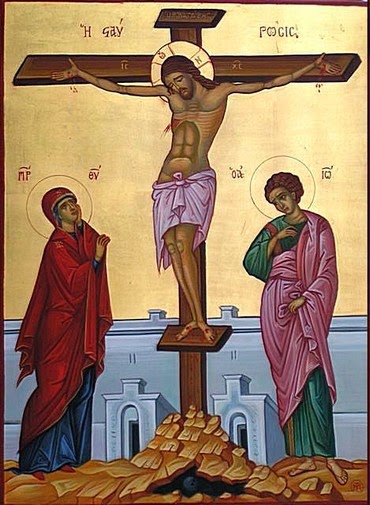
The Triumph of the Cross is the establishment of a new honor/shame code. The obedience of the Son -- filial piety -- conquered the disobedience of the Evil Angel and the first humans. Even more than the sacrificial love that Jesus shows for all of us in His death, it is His obedient love for His Father that is the driving dynamic of this event. Jesus obeys His Father and allows Himself to be publicly humiliated, with His mother close by as a participant in His suffering. Jesus had asked that this cup pass Him, but He submitted to the will of the Father. Obedience to a sacral order, not equality of station, is the road to Victory. This does not abolish honor codes but elevates a new King and incorporates the angels and martyrs in a new court of reputation. This does not do away with shaming and expulsion but dethrones the Prince of this world and scoffs at the glitter and glamour of sin.

The Triumph of the Cross and the Kingdom of God is established by entering into the sacramental order that flows from the side of the Pierced One. That sacramental order reconstitutes the human species as the Body of Christ. The sacramental order is built on a sacral brotherhood that Christ established to maintain His Presence and His sacrifice to the Father on earth throughout time. Through Christ's Church we are incorporated in the interpersonal love of the Trinity. As brothers in Christ we go forth to baptize the nations to effect the Kingdom of God and Triumph of the Cross. The fraternity of priests sustain the Body of Christ in the Eucharistic forms of local Church and earthly Kingdom. The laymen shape civic territorial circles of patriarchal fraternity and order - -some explicitly Christian; others patterned after other transcendental truths. Creating these concentric circles of ordered fraternity bring men into the formations that protect the Eucharistic acts of worship while preparing humanity for the final Coming and Triumph of the Lord.


Saturday, September 14, 2019

September 14: The Triumph of the Cross

"Though He was in the form of God, 

Jesus did not deem equality with God something to be grasped at. 

Rather He emptied Himself and took the form of a slave being born in the likeness of men. 

He humbled himself obediently accepting even death, death on a cross. 

Because of this God highly exalted Him and bestowed on him the name above every other name. 

So that at Jesus' name every knee shall bend in the heavens and on the earth and under the earth and every tongue proclaim to the glory of God the Father: JESUS CHRIST IS LORD!"    

                                                                                                                                 (Philippians) 


The Triumph of the Cross is the establishment of a new honor/shame code. The obedience of the Son -- filial piety -- conquered the disobedience of the Evil Angel and the first humans. Even more than the sacrificial love that Jesus shows for all of us in His death, it is His obedient love for His Father that is the driving dynamic of this event. Jesus obeys His Father and allows Himself to be publicly humiliated, with His mother close by as a participant in His suffering. Jesus had asked that this cup pass Him, but He submitted to the will of the Father. Obedience to a sacral order, not equality of station, is the road to Victory. This does not abolish honor codes but elevates a new King and incorporates the angels and martyrs in a new court of reputation. This does not do away with shaming and expulsion but dethrones the Prince of this world and scoffs at the glitter and glamour of sin.

The Triumph of the Cross and the Kingdom of God is established by entering into the sacramental order that flows from the side of the Pierced One. That sacramental order reconstitutes the human species as the Body of Christ. The sacramental order is built on a sacral brotherhood that Christ established to maintain His Presence and His sacrifice to the Father on earth throughout time. Through Christ's Church we are incorporated in the interpersonal love of the Trinity. As brothers in Christ we go forth to baptize the nations to effect the Kingdom of God and Triumph of the Cross. The fraternity of priests sustain the Body of Christ in the Eucharistic forms of local Church and earthly Kingdom. The laymen shape civic territorial circles of patriarchal fraternity and order - -some explicitly Christian; others patterned after other transcendental truths. Creating these concentric circles of ordered fraternity bring men into the formations that protect the Eucharistic acts of worship while preparing humanity for the final Coming and Triumph of the Lord.


Friday, January 18, 2019

NT Wright's How God Became King. Book Review by Frederick Blonigen


The final Sunday of each liturgical year is the great feast of Christ the King. This universal solemnity of the Church was instituted by Pope Pius XI on December 11, 1925, in his encyclical Quas Primas. The date of this papal document is significant. It was a time of growing materialism and secularism. Soviets had decimated their orthodox clergy and Mexico was killing its priests. The Spanish republicans would join the bloodletting in a decade. A time of ideological fervor and the rise of Communist and Nazi dictatorships in Europe. A time when many were losing hope for humanity as Christianity was bypassed in the exercise of public authority. Pope Pius XI saw the need to reaffirm the absolute sovereignty of God over the affairs of men. Christ and His Church, the pope declared, is the one and only source of salvation. Christ alone is King and Ruler. “It is Christ whom the Father ‘hath appointed as heir of all things: for he must reign until at the end of the world he hath put all his enemies under the feet of God and the Father.’ “It is most fitting and necessary, continues the pope, for the Church to salute the Lord as King of Kings and to remind mankind at the end of the liturgical year that when Christ returns at the Parousia, the Second Coming, He will come in triumph and glory as King of the universe and Judge of all nations.


The role of Christ as King and Ruler is not simply a liturgical celebration commemorated once a year. It is at the very heart of the New Testament. It is the central, and forgotten, message of the four gospels. This is the thesis of N.T.Wright’s fascinating book, How God Became King : The Forgotten Story of the Gospels. Wright, an Anglican bishop, a prolific writer and one of the foremost New Testament scholars in the world, argues there has been a deep seated and persistent misunderstanding. In the opening paragraph of How God Became King, the author explains: “It has been slowly dawning on me over many years that there is a fundamental problem deep at the heart of the Christian faith and practice as I have known them. This problem can be summarized quite easily: we have all forgotten what the four gospels are about. Yes, they are about Jesus, but what exactly are they saying about Jesus? Yes, they are about God, but what precisely are they saying about God? Yes, they are about the beginnings about what later became known as Christianity, but what are they saying about that strange movement, and how do they resource it for its life and work.” Despite centuries of intense and extensive study of the gospels most of the Western Christian tradition, both Catholic and Protestant, has simply missed the main message the four books were trying to convey. The story the four evangelists are telling is the story of how God became king on earth as in heaven.
The problem N.T. Wright is attempting to address in this book is captured memorably in a personal story he tells about an incident that occurred almost fifty years before when the author was still in high school. At the time Wright belonged to a Christian studies group and the members decided to do a series of reports on some aspect of Christ, each report beginning with “Why”. For example, Why was Jesus born , Why did Jesus live? Why did Jesus die? Why did Jesus rise from the dead? For some reason the author ended up with the task of having to do a report on the middle topic: Why did Jesus live? And even at that young age he realized he had been given the most difficult topic to research.
What about that question in the middle—his question? Why did Jesus live ? Did anything worth knowing take place between Jesus’ birth in a stable and His death on Calvary? Why did the four evangelists provide all that information about Christ’s three year long public life? What difference does it make that while we know precious little about Christ‘s first thirty years of life, we know a great deal about His last three? What truths can we learn from Our Lord’s public life? Since Christ was the man who came to earth to die for us and redeem us and atone for our sins what is the point of spending thirty three years on earth, the first thirty in obscurity and the last three living an intensely active public life?
Over a lifetime of studying and teaching the New Testament, N. T. Wright was surprised to discover that these very questions about “Why Christ lived” are seldom raised by many Christians who read the gospels. “Adapting a phrase from a well-known book on management, The Empty Raincoat , such readers experience the four gospels as an empty cloak. The outer wrapping is there—Jesus’ birth, death, and resurrection. But who is inside the cloak? What did Jesus do in between? Is there anybody there? Does it matter?” According to Wright, when most Protestants refer to the “gospel” they are not referring to the four gospels but to the gospel message: the good news that Jesus Christ has died for mankind’s sins ( atonement) and all we have to do is believe ( justification by faith alone). This gospel message isn’t even found in the gospels but in the letters of St.Paul, especially in Romans and Galatians.


This peculiar relationship between the “gospel” and the gospels is also found in the relationship between the “gospel” and the great Christian creeds. The great creeds when they refer to Jesus go from His virgin birth to His suffering and death. The gospels, on the other hand, tell us a great deal about what Jesus did between His birth and His death, especially what might be called His “kingdom-inaugurating” works: “the deeds and words that declared that God’s kingdom was coming then and there, in some sense or other, on earth as in heaven. They tell us a great deal about that; but the great creeds don’t.”
The creeds do not mention anything that occurs in the life of Jesus between His birth and death. To quote Wright: “ What I see is a great gulf opening up between the canon and the creeds. The canonical gospels give us a Jesus whose public career radically mattered as part of his overall accomplishment, which had to do with the kingdom of God. The creeds give us a Jesus whose miraculous birth and saving death, resurrection, and ascension are all we need to know....We have assumed some sort of creedal framework, and the gospels don’t fit it. Have we , then, all misunderstood the gospels? Is there an emptiness at the heart of the great cloak of the creedal gospel? I fear the answer has to be yes....The  gospels were all about God becoming king, but the creeds are focused on Jesus being God. It would be truly remarkable if one great truth of early Christian faith and life were actually to displace another, to displace it indeed so thoroughly that people forgot it even existed. But that’s what I think has happened. This book is written in the hope of correcting that distortion.”
If the focus of the Christian creeds gives us, to use Wright’s metaphor, a cloak without a body ,the opposite problem, all body and no cloak, has been a persistent issue ever since the eighteenth century when Biblical rationalists have come to the gospels with the historical question: Did it really happen? And many of the skeptical scholars answered in the following manner. Yes, Jesus really did exist but all that stuff about His miraculous birth, His miracles, and His death and resurrection: in short, anything supernatural about Jesus never actually happened. But when we take away the creedal framework—the body without the cloak, as it were—the story of the gospels we have left is very different than the one told by the Church. The “liberal” picture of Jesus, says Wright, reduces Our Lord to one of three things. He is either a Jewish revolutionary seeking the violent overthrow of the Roman state. Or He is a fanatical visionary predicting the end of the world. Or He is a mild mannered teacher preaching the Fatherhood of God and the brotherhood of man. Or He is some combination of all of the above. Many Christians have grown up with this liberal, reductionistic view of Jesus. The idea that Jesus came to teach a new ethic of being “nice” to other people without any dogmatic or supernatural claims is deeply embedded in Western culture. That Jesus actually is God, that He was born to die for mankind’s sins and make it possible for us to be saved and that He established a Church to carry on His salvific work seems just too fantastic to believe. Instead of leaving out the middle of the gospels in order to focus on the creeds, the liberal reductionist does just the opposite : he focuses on the middle material in the gospels and ignores or even denies the supernatural claims about Jesus found in the creeds.
The truly orthodox response to this misreading of the gospels is to see them from the perspective of God’s kingdom. “ What I miss, right across the Western tradition “, {says Wright}, “at least the way it has come through the twentieth and twenty-first centuries, is the devastating and challenging message I find in the four gospels: God really has become king—in and through Jesus. A new state of affairs has been brought into existence. A door has been opened that nobody can shut. Jesus is now the world’s rightful Lord, and all other lords are to fall at his feet. This is an eschatological message, not in the trivial sense that it heralds the ‘end of the world’ (whatever that might mean), but in the sense that it is about something that was suppose to happen when Israel’s hopes were fulfilled; and Israel’s hopes were not for the demise of the space-time universe, but for the earth to be full of God’s glory. It is , however, an inaugurated eschatological message, claiming that this ‘something’ has indeed happened in and through Jesus and does not yet look what people might have imagined. That is the story the gospels are telling.”
The argument N.T. Wright makes throughout How God Became King is that the four canonical gospels tell us that the story of Jesus is the story of how Israel’s God became king. That Jesus of Nazareth, the God of Israel, has become the king of the world: this is the forgotten story of the gospels. And in missing this central message we have misread the gospels.


Having established the problem of how the gospels have been misread, Wright then sets out to debunk various inadequate answers to the question of how the reader should understand what happens in the gospels between the birth and death of Jesus, or as he puts it, what’s the purpose of the “body” inside the “cloak”? What is the point of Christ’s healings, the conflicts with the Pharisees and Sadducees, the Sermon on the Mount, the calming of the storm, and all the other rich material found in the “middle “ of the gospels? The first inadequate answer, according to Wright, and the most serious misreading of the gospels, is that Jesus came to teach people how to go to heaven. Wright is not in any way denying that the whole New Testament assumes that God has a wonderful reward prepared for those who do His will in this world, a plan that includes the resurrection from the dead and a new heaven and earth. But, Wright insists, this is not the point of the four gospels. Rather the kingdom of heaven or God’s kingdom is not about people going to heaven but about heaven coming to earth. When St. Mathew has Jesus talking about “the kingdom of heaven” he means that heaven, in other words God’s kingdom and His sovereign rule is being established not just in heaven but also on earth.
A second major misreading of the story in the middle of the gospels, according to Wright, is to reduce Jesus to a teacher of a new ethical theory. In this understanding, Jesus is primarily concerned that people behave well and that His moral teachings, especially in the Sermon on the Mount, are a guide to living a morally upright life. Jesus was , of course , announcing a whole new world and He was “teaching “ His followers how to live good lives within this new world. But Jesus’ teaching must be understood within a larger picture of what He was doing. Without this larger picture, Jesus can easily be reduced to just another great religious teacher, like Buddha or Confucius, who provides His followers with a collection of teachings to live by.
Wright discusses several other false readings of the gospels, concluding with the standard argument that the Matthew, Mark, Luke and John wrote their respective gospels to prove the divinity of Christ and also His humanity. Most readers of the gospels in fact assume that the purpose of the gospels is to demonstrate that Jesus is fully God and fully human. After all, did not the early Church spend a lot of effort in its first few centuries dealing with various heresies, like Arianism and Docetism, heresies that challenged the true identity of Jesus?
The point is not that the four evangelists do not think Jesus is divine but that is not the primary thing they are trying to convey. They presuppose Christ’s divinity. The issue for the evangelists is not whether Jesus is God but what God is doing in and through Jesus. In other words, for the evangelists Jesus is indeed the Messiah. In this man,  and in him alone, we see how God is establishing his kingdom in this world. And if Jesus is the Messiah then his public life is how Israel’s God is establishing his kingdom on earth as it is in heaven. If Jesus is the Messiah, then it is through this greatest anointed king of Israel that God himself is revealing who he is.
For N.T.Wright the misreading of the New Testament, and specifically the gospels, begins with the Old Testament. Unless we understand correctly the story of Israel we can make no sense of the gospels. The problem is that too often we have read the gospels as simply God’s answer to the fallen state of humanity. The back story of the gospels is not the story of Abraham, Moses, and David but Adam and Eve (representing all mankind) sinning and in need of a Redeemer. For many modern readers of the Bible the story of the Chosen People seems to be a kind of side show. But that is not the way Matthew, Mark, Luke and John see it. They believe that it is critically important to retell the history of Israel and to show how the story of Jesus is the story in which the long and painful history of Israel reaches its climax. The Old Testament story of the Israelites is the story of the people God had chosen from all eternity to be the means through which he would create his kingdom on earth. To again quote the beautiful words of Wright, “The call of Abraham is the answer to the sin of Adam. Israel’s story is thus the microcosm and the beating heart of the world’s story, but also its ultimate saving energy. What God does for Israel is what God is doing in relation to the whole world. That is what it meant to be Israel, to be the people who, for better and worse, carried the destiny of the world on their shoulders. Grasp that and you have a pathway into the heart of the New Testament.”
It is Wright’s argument that unless we read the gospels and the story of Jesus as the fulfillment of the story of Israel, we will miss their central message. Especially since the skepticism of the 18th century Enlightenment, Western Christians have reacted by reading the gospels as a story of Jesus the God Incarnate but have not listened carefully to what the evangelists are saying regarding which God they are talking about and what exactly this God is doing. For too long Christians have seen the story of Jesus as primarily hooked up to human sin in Genesis and not with the story of Israel. On that reading, after the Israelites failed to keep their covenant with God and rejected his Son as the Messiah, God had a second plan through which Jesus would be born, suffer, die and rise from the dead and all those who would believe in him would be saved. But the story of Jesus is the story of Israel’s God , the Creator and the Savior, who has come to earth to dwell among his people and to establish his kingdom. The fulfillment of Israel’s story is the story of Jesus and the founding of God’s renewed people. In establishing his Church, Jesus does not so much replace the Chosen People as renew and fulfill them. The Church then is the launching of God ‘s renewed people.
The entire story of Israel , on one level, is how Israel’s God takes on and defeats the arrogant tyrants of the world and destroys their pagan idols. At Babel God confused the tongues of those who in their pride were attempting to build a kingdom without God. The call of Abraham is God’s response to the arrogance of man. God allows the Israelites to be enslaved in Egypt but he sends Moses to rescue them and lead them to freedom. Through David’s defeat of Goliath, God again rescues his people from the Philistines . Over and over the God of Israel defeats Israel’s enemies, the kingdoms of the world are no match for the kingdom of God. It’s the same story throughout the Old Testament and it is the same story the gospels writers are telling in the story of Jesus himself.
The early Christian writers believed that they were setting forth an eschatology that had been inaugurated but not fulfilled. They believed that they were living between the accomplishment of God’s reign on earth in Jesus and its full implementation in the future. But the eschatology they believed and preached was not just personal or spiritual; it was social, political, cultural, even cosmic in its dimensions. For the New Testament writers the new creation has already begun and will be completed. Jesus is even now ruling over the new creation in and through his Church. The ruler of this world has been defeated and God is king on earth as he is in heaven. That is the truth the gospels are so eager to tell.
The difficulty understanding this reading of the gospels is in large part the result of separating the kingdom from the cross. The story Matthew, Mark, Luke , and John tell is how God became king in and through Jesus both in his public life and in his death. To again quote Wright,” ‘To suffer and then come into his glory’—in other words, cross and kingdom. The very word ‘Messiah’ already implies kingdom; now it is clear how that kingdom is attained. This is how the story of Israel comes to its climax. The suffering of Israel’s representative has drawn the sting of the world’s evil; Luke made it clear that Jesus’ betrayal, arrest, and death were the point where at which the powers of darkness were doing their worst (22:53). Now the original vision of Israel can at last get back on track. The other three evangelists have their own way of getting at the same point, but we have every reason to believe that they would have agreed. The first reason we can be sure that kingdom and cross belong tightly together in mutual interpretation is that this is the way gospel writers saw the story of Israel reaching its climax in the story of Jesus.”
God‘s worldwide sovereignty on earth as in heaven: the central goal of Jesus’ mission and the reason for his life, death and resurrection. How can we understand this? God called Israel to be the means to rescue the world specifically in the person of Jesus the Messiah. The purpose of the gospels is to tell the story of how God‘s kingdom is established through the obedient suffering of Jesus. This task can only be accomplished by God himself. This is not only the heart of the gospels, but of the entire Bible.
The gospel story of Jesus inaugurating a new people of God, the Church, includes the amazing transformation of the apostles after they became witnesses to the Risen Christ and after they are enlightened by the Holy Spirit at Pentecost. For the early disciples the kingdom and the cross were not mere theological abstractions but the consistent pattern of their lives. Therefore, we should not be surprised to learn that for the early Christians being a follower of Jesus necessarily included their own suffering and often death. It was not just that as followers of a misunderstood Jesus the early Christians could also expect to be misunderstood and persecuted. But that in God’s providence, like the suffering of Jesus, their own suffering would be the means God would use to fulfill his divine purpose.
The suffering and death of Jesus ’people, in other words, is not simply the negative side of following someone whose person and message were rejected with great hostility and hatred. But it has the positive effect of advancing the redemptive work of Jesus not by adding to it but by sharing in it. Jesus called his followers to inaugurate his kingdom; that is the point of sending out the Twelve during his lifetime and after His death and resurrection. But if his disciples are to bring His kingdom to the world according to the Master’s way, they will be people who share in His suffering. That is the mysterious and paradoxical way, the divine way, the kingdom of God will be fulfilled.
This is the correct way to understand the entire New Testament vision of the Church. The renewed people of God are sent on the great mission of suffering kingdom-bringers.


This inseparable relationship between the cross and the kingdom, for Christ and his followers, is captured beautifully in the book of Revelation:
Glory to the one who loved us, and freed us from
our sins by his blood, and made us a kingdom, priests to his
God and father. ( 1:5-6)
You are worthy to take the scroll;
You are worthy to open its seals;
For you were slaughtered and with your own blood
You purchased a people for God, From every tribe and tongue, From every people and nation,
And made them a kingdom and priests to our God
And they will reign on the earth ( 5: 9-10)
This vision of a people rescued by the cross of Christ and transformed into kingdom-bringers is the story the four evangelists are telling: it is the message of the gospels that so many have missed. “The implicit ecclesiology of all four gospels is a picture of a community sharing the complex vocation of Jesus himself: to be kingdom-bringers, yes, but to do this first because of Jesus’ own suffering and second by means of their own. The slaughtered and enthroned lamb of Revelation 5 is not only the shepherd of his people; he is also their template. Sharing his suffering is the way in which they are to extend his kingdom in the world.”
In the Old Testament, the Temple in Jerusalem is the most sacred place on earth for it is where God is uniquely present to his people. In the New Testament, Jesus is now the living Temple of God, he is now the person in whom earth and heaven meet. The event which accomplishes this meeting is His crucifixion on Calvary. The cross is Christ ‘s victory over sin, Satan, death itself. The cross is the victory of God ‘s kingdom over all the world’s kingdoms . The cross is the victory of God himself over all the powers and evil, both human and demonic, of this world. True theocracy or the rule of God can now be established because the false rulers of this world have been defeated.
Without the cross, the rule of Satan remains in this world. That is why for all the evangelists the cross is the final and ultimate task of theMessiah. His death on the cross is the defeat of the Evil One. Sin  has been conquered. The great Accuser has lost his kingdom. And now the Creator and Redeemer of the world can launch his new creation. The crucifixion of Jesus was the long prophesized way in which the Messiah would come to be king of all the world. The purpose of Jesus’ dying on the cross –the gospels are telling us—is to establish God’s kingdom on earth as in heaven. In all four gospels the message is clear: the coming of God’s kingdom, the sovereign rule of Israel’s God, has arrived in the person of Jesus, David’s true heir and royal son. The kingdom comes in a way unexpected and deeply mysterious. When Jesus stretches out His arms on the cross to embrace all mankind and to suffer the most ignominious death for all the sin and evil in the world, it was God ‘s definitive statement that divine love is stronger than evil and death. Christ’s suffering and death on the cross was his glorification, his enthronement.


To quote the magnificent words of Wright, “We have, alas, belittled the cross, imagining it merely as a mechanism for getting us off the hook of our own petty naughtiness or as an example of some general benevolent truth. It is much, much more. It is the moment when the story of Israel reaches its climax; the moment when at last the watchmen on Jerusalem’s walls see their God coming in his kingdom; the moment when the people of God are renewed so as to be, at last, the royal priesthood who take the world over not with the love of power but with the power of love; the moment when the kingdom of God overcomes the kingdoms of the world. It is a moment when a great door, locked and barred since our first disobedience, swings open suddenly to reveal not just the garden, opened once more to our delight, but the coming city, the garden city that God had always planned and is now inviting us to go through the door and build with him.”
It is Wright’s argument throughout this book that the tragedy of modern Christianity is that while the “orthodox” have preferred the creed to the kingdom and the “unorthodox” have tried to have a kingdom without a creed, it is time to unite what never should have been separated. The gospels tell the story of how in Jesus the living God has become the king of the whole world. Reading, praying, and living these gospels is  how Christians build God’s kingdom in our world, a world whose meaning and purpose can only be found in the humble and loving worship of Christ the King.
The thesis that N.T.Wright so convincingly sets forth in How God Became King, is not without its flaws, especially for a Catholic reader. There is no Eucharist, no Apostolic priesthood and thus no  living structural Ecclesiology. For all the talk of kingship there is no harrowing of hell and Apostolic thrust to baptize the nations.  From a Catholic perspective, since we see the Eucharist as the source and summit of the faith, this is a major flaw, indeed. For the Eucharist not only draws us into the suffering of the cross but reconstitutes humanity as the Risen Body. Without the Eucharist there is no Church; there is no Mystical Body of Christ; there is no judgement of the nations; there is no kingdom of God on earth as in heaven. But still this is a  riveting book.
One way of showing how Wright’s thesis could be strengthened and completed is to look at the Luminous Mysteries of the Rosary, mysteries added to the Rosary by St. Pope John Paul II in his beautiful and moving 2002 Apostolic Letter Rosarium Virginis Mariae (On the Most Holy Rosary). It seems Pope John Paul II like Wright saw the mysteries of the rosary(like the Creed) recounting the childhood of Christ(the Fifth Joyful Mystery ends with the Finding in the Temple ) and  resumes on the night before He died (First Sorrowful Mystery -The Agony in Garden). Maybe John Paul saw what Wright saw.  The Gospels in between seem missing.


As Pope John Paul explains in his letter, if the Rosary is to be prayed as a true “compendium of the gospel” then key events in Christ’s public life need to meditated upon as well. When we move from Our Lord’s infancy and hidden life in Nazareth, our contemplation then should bring us to those mysteries which in a special way can be called “luminous” or “mysteries of light”. Of course, the whole mystery of Christ is a mystery of light for he is the “Light of the world”. But this truth becomes especially clear during Christ’s public life when he proclaims the Gospel of the Kingdom. The five mysteries of light John Paul gives to the Church for its meditation are : 1.The Baptism of Jesus in the Jordan 2.His self manifestation at the wedding of Cana 3.His proclamation of God’s kingdom and call to conversion 4. His Transfiguration and 5. His institution of the Eucharist at the Last Supper. Each of these mysteries is a revelation of God’s kingdom in the very person of Jesus.
The Eucharist, however, is the sacrament of sacraments for it not only gives us grace, it gives us the author of grace, God himself. From the perpetuation of the sacrifice of the cross and her communion with the body and blood of Christ the Church in her members is renewed and given the spiritual strength to carry out her divine mission in the world: the communion of all mankind with Christ and in him with the Father and the Spirit. The Eucharist builds the Church and the Church makes the Eucharist. One reality makes no sense without the other.


N.T. Wright’s thesis in How God Became King is persuasive and compelling. Let his Catholic elder brother St.John Paul II complete his argument.  In 2003 in what was to be his last encyclical letter Ecclesia de Eucharistia ( On the Eucharist in its Relationship to the Church) , John Paul said, “Every commitment to holiness, every activity aimed at carrying out the Church’s mission, every work of pastoral planning, must draw the strength it needs from the Eucharistic mystery and in turn be directed to that mystery as its culmination. In the Eucharist we have Jesus, we have his redemptive sacrifice, we have his resurrection, we have the gift of the Holy Spirit, we have adoration, obedience and love of the Father.” And, yes, we have the Son who was born to be the King of the Jews, the Savior of mankind, the Head of His Mystical Body, the King of Kings and the ruler of all nations and the Universe.


Saturday, April 4, 2026

HOLY SATURDAY: Christ the Conqueror of Hell

[first published April 19, 2014]


by David Pence                  


Holy Saturday always seems the most mysterious day of the Church calendar. We are in between two vivid earthly scenes. The first is depicted in the last three Stations of the Cross: Christ’s death, His return to His mother’s arms, and His burial. The second event is on Sunday as eyewitnesses register their stunning reports. Christ’s last words commending his spirit to the Father, and pronouncing his suffering now consummated, are deeply comforting after a night and a day of torture. But what happened from the time of his death to the sighting on Easter morning?

When David went to slay Goliath, he rejected the sword of Saul. He brought five smooth stones – and trust in the Living God –  to his contest. When Christ went to his agony he ordered the sword of Peter back in the scabbard; and bore five open wounds, and trust in His Father, to the Cross.

David brought back the head of his foe to Jerusalem, and many say Golgotha is called the place of a very particular skull (the Philistine giant's). It sits over a grave as well: Adam’s. Christ, too, decapitated his foe – the Prince of this world – no longer Master and now deprived of his sting of death. David’s Lord delivered Adam, Abraham, and a host of others from the prison of death on this day. In the Eastern Church the triumph of the resurrection is depicted as the liberation of the captives. The resurrection of Christ delivers men from the bondage of Satan and initiates the ‘theosis’ of men. The liberated take their place in the Body of Christ, Who will soon be at the right hand of the Father. Finally, we will see man in his proper place.

The Dragon, meanwhile, mortally wounded – and stunned by the loss of so many souls – plots revenge against the new apostolic church which is sent out to exorcise demons, forgive sins, and baptize the nations into a worshipful fighting formation that will ultimately separate Satan from the land of the living.

Holy Saturday emits the same mysterious scent as the time between the Creation/Fall events of the Angels, and the first manifestation of matter. Pivotal angelic contests, transmitted in the shared patristic traditions of the Orthodox and Catholics, flesh out the Biblical narrative. These are not ancillary optional tales of the olden days. Only a drama employing the full cast of divine, angelic, and human characters can hope to present the cosmic scope of these high holy days of our liturgical life.  We learn about these characters as much from liturgical and patristic sources as from Scripture. This fuller view reminds us not to shrink the glory of this upcoming Octave of Easter to the return of "our friend Jesus" as an individual man who beat the Grim Reaper. Christ slew death and rises from the depths of a netherworld where he triumphed in a terrific battle. This is as much Bastille Day as a replay of Lazarus!

The Risen Christ is truly different. He now incorporates thousands of the liberated in His perfecting Body. He has freed our father Adam, and demonstrated the original mission of man: to take back from Satan his unlawful dominion on earth. No wonder our Lord looked so different -- even to those who knew Him best.


UPDATE:  Here are some further links on the subject. Probably the most compelling of all reflections on Holy Saturday is included in the Church's office of readings for this day. Read here an anonymous and ancient homily about our Lord’s harrowing of hell.

This 2002 sermon delivered in Minneapolis, Minnesota, is a learned historical contrast of the Eastern and Western traditions on the meaning of this day and its implications for a time of decision after death for all men. Bishop Hilarion Alfeyev is one of the leading lights of the Russian Orthodox Church.

Also a post by Taylor Marshall, which explains the bizarre teaching of the late Hans Urs von Balthasar; and an exchange in 'First Things'  between a critic and a priestly defender of the Swiss theologian.

This short video on the two Adams is a beautiful refection on the harrowing of Hell and the meaning of Holy Saturday. It is a stunning audiovisual using the complete text of the ancient homily referenced above from the Church's office of readings for today. This is an explanation of the icon above.

Saturday, April 11, 2020

HOLY SATURDAY: Christ the Conqueror of Hell

[first published April 19, 2014]


by David Pence                  


Holy Saturday always seems the most mysterious day of the Church calendar. We are in between two vivid earthly scenes. The first is depicted in the last three Stations of the Cross: Christ’s death, His return to His mother’s arms, and His burial. The second event is on Sunday as eyewitnesses register their stunning reports. Christ’s last words commending his spirit to the Father, and pronouncing his suffering now consummated, are deeply comforting after a night and a day of torture. But what happened from the time of his death to the sighting on Easter morning?

When David went to slay Goliath, he rejected the sword of Saul. He brought five smooth stones – and trust in the Living God –  to his contest. When Christ went to his agony he ordered the sword of Peter back in the scabbard; and bore five open wounds, and trust in His Father, to the Cross.

David brought back the head of his foe to Jerusalem, and many say Golgotha is called the place of a very particular skull (the Philistine giant's). It sits over a grave as well: Adam’s. Christ, too, decapitated his foe – the Prince of this world – no longer Master and now deprived of his sting of death. David’s Lord delivered Adam, Abraham, and a host of others from the prison of death on this day. In the Eastern Church the triumph of the resurrection is depicted as the liberation of the captives. The resurrection of Christ delivers men from the bondage of Satan and initiates the ‘theosis’ of men. The liberated take their place in the Body of Christ, Who will soon be at the right hand of the Father. Finally, we will see man in his proper place.

The Dragon, meanwhile, mortally wounded – and stunned by the loss of so many souls – plots revenge against the new apostolic church which is sent out to exorcise demons, forgive sins, and baptize the nations into a worshipful fighting formation that will ultimately separate Satan from the land of the living.

Holy Saturday emits the same mysterious scent as the time between the Creation/Fall events of the Angels, and the first manifestation of matter. Pivotal angelic contests, transmitted in the shared patristic traditions of the Orthodox and Catholics, flesh out the Biblical narrative. These are not ancillary optional tales of the olden days. Only a drama employing the full cast of divine, angelic, and human characters can hope to present the cosmic scope of these high holy days of our liturgical life.  We learn about these characters as much from liturgical and patristic sources as from Scripture. This fuller view reminds us not to shrink the glory of this upcoming Octave of Easter to the return of "our friend Jesus" as an individual man who beat the Grim Reaper. Christ slew death and rises from the depths of a netherworld where he triumphed in a terrific battle. This is as much Bastille Day as a replay of Lazarus!

The Risen Christ is truly different. He now incorporates thousands of the liberated in His perfecting Body. He has freed our father Adam, and demonstrated the original mission of man: to take back from Satan his unlawful dominion on earth. No wonder our Lord looked so different -- even to those who knew Him best.


UPDATE:  Here are some further links on the subject. Probably the most compelling of all reflections on Holy Saturday is included in the Church's office of readings for this day. Read here an anonymous and ancient homily about our Lord’s harrowing of hell.

This 2002 sermon delivered in Minneapolis, Minnesota, is a learned historical contrast of the Eastern and Western traditions on the meaning of this day and its implications for a time of decision after death for all men. Bishop Hilarion Alfeyev is one of the leading lights of the Russian Orthodox Church.

Also a post by Taylor Marshall, which explains the bizarre teaching of the late Hans Urs von Balthasar; and an exchange in 'First Things'  between a critic and a priestly defender of the Swiss theologian.

This short video on the two Adams is a beautiful refection on the harrowing of Hell and the meaning of Holy Saturday. It is a stunning audiovisual using the complete text of the ancient homily referenced above from the Church's office of readings for today. This is an explanation of the icon above.

Friday, April 3, 2026

GOOD FRIDAY: the Anthropology of Sacrifice

[first published April 18, 2014]


by David Pence

"Ecce Homo" (1881)
by St. Albert Chmielowski

Lord has been pleased to crush him with suffering."  (Isaiah 53)

On this Good Friday let us renew an old custom of speaking no words, except those of the liturgy or communal prayer during the three hours of Christ’s hanging on the cross from noon to three o'clock. (If we define the crucifixion as His taking up the cross and the journey up Calvary commemorated in the stations, the ordeal began at 9am), If ever there was a day that our Christian nation should declare as holy, it should be this day of the ultimate sacrifice.

Anthropologists say there are three elements to every sacrifice:

 1) a setting aside
 2) a sacred killing
 3) a communion

In many animal sacrifices a setting aside of some specially designated animal, a killing of the animal often by a set aside priest is followed by some portion of the animal being eaten as a sign of union between those who eat and the gods. In Christ’s sacrifice we see the setting aside of the one perfect Victim -- the Anointed One (Christos). We hear him cry out: "My God, My God, why hast Thou forsaken me?" And He is killed.

As we leave that haunted hill (where some say David buried the skull of Goliath and others call the Tomb of Adam) we read the rest of the words of Psalm 22 which Jesus invoked. After many verses depicting the numbering of his bones and the casting of lots for his garments, we hear that the innocent victim “will proclaim your name in the assembly,” that “all the ends of the earth will worship you,” and that “deliverance is brought to a people yet unborn.” When we read the “forsaken verse” in the context of the whole Scripture and the practice of the Church, we find our Lord foretelling the Communion that will come from his sacrifice. From his vantage on the cross, our Lord sees the Masses of the future made present at Calvary. From the ends of the earth, God's name is proclaimed in the liturgical assemblies.
                                                         

Moderns hesitate at the language of sacrifice. They would rather tell the story of Christ in the language of nonviolence and the salvation of all. It seems too primitive and bloody a tale. But sacrifice entails separation and killing—a sword that divides and a sword that slays. These must precede Communion. It is part of the Grammar of Sacrifice. Sacrifice ('sacrum facio) means to make holy. Holiness is not so much a statement about morality as one about separateness. We are being offered access to the One Who is Separate. "I am God who art Holy and because I am Holy you shall be Holy." In our prayers and gestures and liturgy, God must be approached as the HOLY ONE who is ultimately separate from all creation because He is the Creator. There is also in this cast of characters an unredeemable Evil One who has spread a pall of death, sickness, and darkness over humanity. In some radical way, man must be separated from the world, the flesh and the devil. All three must be killed for man to enter fully into communion with the God who is Holy.

The cosmos -- which man has only very recently begun to depict accurately -- is revealing to us the reality of election amidst widespread dissipation. Most of matter is heading out into oblivion, and those huge frightening angelic creatures who have been cast out of heaven and now roam the earth seeking the ruin of souls are going to be cast into the isolation of death at the final reckoning. Christ died to restore humans to our original mission and our role as priests, who in the ultimate sacrificial drama are going to participate in the killing of the victim who deserves to be slain. We will join in the exorcism of the Evil One. He was cast out of heaven by Michael. At the death of Christ, he was dethroned from the netherworld. Through the priestly power of the Church from now until the Last Judgment we are participating in casting Him out of our lives into Hell.

Adam was the first set-aside priest who was supposed to cooperate with the Angels in obeying the will of God to cast out Satan and dominate the earth. Out of all matter in the galaxies, some matter on the planet Earth was set aside for life. Out of the soil of life, only Adam was formed by a spiritual soul. Adam failed in his mission, so the new Adam came and died for the sins of humanity. We are now restored to our original mission. Our salvation is not the end of the story. We have been let out of jail to resume the contest that precedes communion. From now on, at the Mass we are at Calvary with the one-time victim who has become the eternal high priest; and the killing is of Satan, sin, self and death itself. The communion is the assembly of the new people foretold in Psalm 22. Those words of Our Lord seemed a cry of despair, but were indeed a promise of the means of our salvation and the restoration of our nature. Christ died on the cross first and foremost to obey the Will of His Father. It is his act of filial piety that returns mankind through our Head to communion with the Father. It is the Atonement. His perfect sacrifice has been done once and for all but we keep bringing those more deserving victims of self, sin and Satan to be killed as well.


Good Friday was predicted:
"As Moses lifted up the serpent in the wilderness, so must the Son of man be lifted up."


And the Eucharist initiating the great separation of the Last Judgment was likewise foretold:
"Now is the judgment of this world: now shall the prince of this world be cast out. And I, if I be lifted up from the earth, will draw all men to myself."


"The LORD is king, and he rules the nations... All mortal men will bow down before him."                                    (Psalm 22)          The Cross is a Triumph.

Friday, April 10, 2020

GOOD FRIDAY: the Anthropology of Sacrifice

[first published April 18, 2014]


by David Pence

"Ecce Homo" (1881)
by St. Albert Chmielowski

Lord has been pleased to crush him with suffering."  (Isaiah 53)

On this Good Friday let us renew an old custom of speaking no words, except those of the liturgy or communal prayer during the three hours of Christ’s hanging on the cross from noon to three o'clock. (If we define the crucifixion as His taking up the cross and the journey up Calvary commemorated in the stations, the ordeal began at 9am), If ever there was a day that our Christian nation should declare as holy, it should be this day of the ultimate sacrifice.

Anthropologists say there are three elements to every sacrifice:

 1) a setting aside
 2) a sacred killing
 3) a communion

In many animal sacrifices a setting aside of some specially designated animal, a killing of the animal often by a set aside priest is followed by some portion of the animal being eaten as a sign of union between those who eat and the gods. In Christ’s sacrifice we see the setting aside of the one perfect Victim -- the Anointed One (Christos). We hear him cry out: "My God, My God, why hast Thou forsaken me?" And He is killed.

As we leave that haunted hill (where some say David buried the skull of Goliath and others call the Tomb of Adam) we read the rest of the words of Psalm 22 which Jesus invoked. After many verses depicting the numbering of his bones and the casting of lots for his garments, we hear that the innocent victim “will proclaim your name in the assembly,” that “all the ends of the earth will worship you,” and that “deliverance is brought to a people yet unborn.” When we read the “forsaken verse” in the context of the whole Scripture and the practice of the Church, we find our Lord foretelling the Communion that will come from his sacrifice. From his vantage on the cross, our Lord sees the Masses of the future made present at Calvary. From the ends of the earth, God's name is proclaimed in the liturgical assemblies.
                                                         

Moderns hesitate at the language of sacrifice. They would rather tell the story of Christ in the language of nonviolence and the salvation of all. It seems too primitive and bloody a tale. But sacrifice entails separation and killing—a sword that divides and a sword that slays. These must precede Communion. It is part of the Grammar of Sacrifice. Sacrifice ('sacrum facio) means to make holy. Holiness is not so much a statement about morality as one about separateness. We are being offered access to the One Who is Separate. "I am God who art Holy and because I am Holy you shall be Holy." In our prayers and gestures and liturgy, God must be approached as the HOLY ONE who is ultimately separate from all creation because He is the Creator. There is also in this cast of characters an unredeemable Evil One who has spread a pall of death, sickness, and darkness over humanity. In some radical way, man must be separated from the world, the flesh and the devil. All three must be killed for man to enter fully into communion with the God who is Holy.

The cosmos -- which man has only very recently begun to depict accurately -- is revealing to us the reality of election amidst widespread dissipation. Most of matter is heading out into oblivion, and those huge frightening angelic creatures who have been cast out of heaven and now roam the earth seeking the ruin of souls are going to be cast into the isolation of death at the final reckoning. Christ died to restore humans to our original mission and our role as priests, who in the ultimate sacrificial drama are going to participate in the killing of the victim who deserves to be slain. We will join in the exorcism of the Evil One. He was cast out of heaven by Michael. At the death of Christ, he was dethroned from the netherworld. Through the priestly power of the Church from now until the Last Judgment we are participating in casting Him out of our lives into Hell.

Adam was the first set-aside priest who was supposed to cooperate with the Angels in obeying the will of God to cast out Satan and dominate the earth. Out of all matter in the galaxies, some matter on the planet Earth was set aside for life. Out of the soil of life, only Adam was formed by a spiritual soul. Adam failed in his mission, so the new Adam came and died for the sins of humanity. We are now restored to our original mission. Our salvation is not the end of the story. We have been let out of jail to resume the contest that precedes communion. From now on, at the Mass we are at Calvary with the one-time victim who has become the eternal high priest; and the killing is of Satan, sin, self and death itself. The communion is the assembly of the new people foretold in Psalm 22. Those words of Our Lord seemed a cry of despair, but were indeed a promise of the means of our salvation and the restoration of our nature. Christ died on the cross first and foremost to obey the Will of His Father. It is his act of filial piety that returns mankind through our Head to communion with the Father. It is the Atonement. His perfect sacrifice has been done once and for all but we keep bringing those more deserving victims of self, sin and Satan to be killed as well.


Good Friday was predicted:
"As Moses lifted up the serpent in the wilderness, so must the Son of man be lifted up."


And the Eucharist initiating the great separation of the Last Judgment was likewise foretold:
"Now is the judgment of this world: now shall the prince of this world be cast out. And I, if I be lifted up from the earth, will draw all men to myself."


"The LORD is king, and he rules the nations... All mortal men will bow down before him."                                    (Psalm 22)          The Cross is a Triumph.

Friday, August 18, 2017

Keeping Catholic Time: Living the Liturgy of Feasts and Seasons

  1. Advent and the Three Comings of Christ
  2. Dec 3: St Francis Xavier:  Completing the Body of Christ in the East
  3. December 8: The Immaculate Conception
  4. December 12: Queen of Mexico, Our Lady of the Americas
  5. Father and Sons Defending the Sacred: The Real Hanukkah Lesson
  6. Christmas: Mortals Shout the Mighty Chorus…
  7. December 28: The Feast of the Holy Innocents
  8. January 1: Consecrating masculine fraternity - the formalized covenant of circumcision 
  9. January 6: The Feast of the Epiphany and the true Age of Enlightenment
  10. Baptism of Christ - Theophany
  11. Baptism of Jesus
  12. January 28: St Thomas Aquinas - Priest and Scholar
  13. Candlemas: A Light to the Nations
  14. February 22: The Chair of Peter
  15. March 19: St Joseph Husband and Protector
  16. March 25: Lady Day
  17. Ash Wednesday: Inquisitions and Penitentiaries
  18. Holy Week
  19. Holy Thursday: He who cleansed the temple, now cleansed the priesthood
  20. Good Friday: The Anthropology of Sacrifice
  21. Holy Saturday: Christ the Conqueror of Hell
  22. Easter: A nation delivered from slavery; a species restored to life
  23. Divine Mercy Sunday: On that day are open…
  24. Good Shepherd Sunday: The Shepherd - Protector or Nursemaid?
  25. May 1: St. Joseph the Worker: Shopcraft and Soulcraft
  26. May 13: Our Lady of Fatima - The promise of the Rosary and Christian Russia
  27. Ascension Thursday: Thus, began man’s participation…
  28. Pentecost: Holy Spirit, Apostolic Church, Humanity and the Trinity
  29. Mary, Mother of the Church
  30. Solemnity of the Holy Trinity
  31. Corpus Christi: Lessons from Nature and History
  32. From Personal Piety to Social Kingship: the ordered loves of the Sacred Heart
  33. June 3: Ugandan martyrs, pray for us
  34. June 29: Solemnity of St Peter and Paul - What is an Apostolic Church?
  35. July 11: Memorial of St Benedict
  36. July 31: Memorial of St Ignatius of Loyola
  37. August 4: St John Vianney
  38. August 5: Dedication of the Basilica of Mary
  39. August 6: Feast of the Transfiguration
  40. August 8: Memorial of St Dominic
  41. August 15: Feast of the Assumption - Breaking the Glass Ceiling
  42. August 22: Queenship of Mary: Ruling from the Inside
  43. August 25: St Louis : Authority and the Ruler
  44. September 14: The Triumph of the Cross
  45. September 29: Feast of the Archangels
  46. October 4: The Feast of St. Francis
  47. October 7: Feast of Our Lady of the Rosary
  48. October 12: Mary, Columbus, and Catholic America
  49. October 15: Theresa of Avila Virgin and Doctor
  50. All Saints Day: Four Men in Full
  51. All Souls Day: Remember, Venerate, Pray
  52. November 9: Feast of the Dedication of the Lateran Basilica in Rome
  53. November 18: Dedication of Sts. Peter and Paul Basilica
  54. November 30: St. Andrew and the Holy Monks of St Athos
  55. Bend the knee to Christ the King

Thursday, November 3, 2016

Christian Realism: An Honest man without God—the Dilemma of Francis Fukuyama [part 1]


[first published May 12, 2016]


by David Pence


Francis Fukuyama writes big books about big subjects. His father was an American-born son of a Japanese father who had fled conscription during the Russo-Japanese War of 1905. His paternal grandparents were interned during the Second World War, but his dad and aunts were in Midwest colleges and thus spared. His father became a Congregational minister who then received a degree in sociology at the University of Chicago, and became a college Religious Studies professor. In all the many interviews with Professor Fukuyama no one thought it interesting to ask if his father’s movement from being a Christian minister to a teacher of Religious Studies meant that he had traded believing and praying to Christ for studying about religion as a sociological function.

Mr. Fukuyama’s mother came to the United States after WWII from her homeland in Japan. Francis was an only child, and remembers from many dinner-table conversations that he was more conservative than his father. Fukuyama received a BA in Classics at Cornell where he was shaped by his academic encounter with Allan Bloom (Closing of the American Mind). He spent a year in France and came in contact with Jacques Derrida, which left him with an intellectual and visceral distaste for the deconstructionist project. At Harvard he turned to political science and was inspired by Samuel Huntington (Soldier and State, The Clash of Civilizations). Unlike most professors but similar to Bloom, Huntington was cross-disciplinary. He asked big questions and proposed synthesizing paradigms. Fukuyama’s voracious intellect has been moved to do the same. (CNN world affairs journalist Fareed Zakaria is another student of Huntington.) After his studies, Fukuyama worked in policy development at the State Department and at the Rand Corporation. He wrote his doctoral thesis on the Soviet Union in the Mideast.

In 1989 as the Berlin Wall fell and the Soviet Union imploded, the 37-year-old Fukuyama was invited by his old teacher Alan Bloom to give a lecture at the University of Chicago called "The End of History?"  His talk was a rare combination of history and classical political philosophy that was not well understood by later critics, but the lecture won the social recognition of his old teacher.  A "neoconservative" journal, The National Interest, published Fukuyama’s subsequent article "The End of History?" and the author was lionized and demonized into that rare but relished social niche: a true public intellectual. In 1992 Fukuyama published The End of History and the Last Man as a book, and in 2006 re-published with a new afterword. The question mark in the earlier essay was gone.
         

Fukuyama’s thesis was that liberal democracy might be "an endpoint of human ideological evolution" and the "final form of human government." Georg Hegel (German philosopher of history: 1770-1831), Karl Marx (German philosopher, author of Communist Manifesto: 1818-1883) and Alexandre Kojeve (Russian-born French philosopher / Hegelian: 1902-1968) all agreed that the history of human social organization was moving toward some final end... with Karl Marx seeing this as the falling away of the state and the emergence of the classless society of Communism. Mr. Fukuyama was acutely aware of what is largely forgotten today -- that this Marxist vision of the grand narrative of human history  was shared by a large portion of university intellectuals until the great unraveling of the Soviet Union. His essay had an ironic bite for the Marxist intellectuals: "Hey guys, guess things didn’t work out in the countries that tried communism as well as in your classrooms." An understated element in his paper was the simple acknowledgement that the inevitability of communism no longer qualified as being on "the right side of history." Unlike post-modern deconstructionists and foreign policy realists, Fukuyama was not going to leave the matter there. He proposed with a question mark that possibly liberal democracy and free markets were the real end form of historical social organization. They offered the best forms to achieve liberty and equality -- two of the driving forces in history. The "end of history" didn’t mean "events were coming to an end." It didn’t even mean that liberal democracies would prevail everywhere in the next 50 years. His argument was first that there is a Human History with a big H. That is true because there is a human nature. These were philosophical statements which were especially aimed at the dominant school in international relations: the so-called realists. He notes (in a chapter 'The Unreality of Realism'): "…theorists of international relations talk as if history did not exist—for example as if war and imperialism were permanent aspects of the human horizon…While all other aspects of human social environment—religion, the family economic organization, concepts of political legitimacy—are subject to historical evolution, international relations is forever identical to itself; war is eternal." This is a crucial distinction between Fukuyama and the so-called realists who dominate international relations in academia. Fukuyama’s teacher Allan Bloom also believes in human nature and the triumph of the West. In his summation of  his student’s "bold and brilliant article," he said:
"As Fukuyama underlines, it is the ideas of freedom
and equality that have animated the West and have
won by convincing almost all nations that they are
true, by destroying the intellectual and political
foundations of alternative understandings of justice.
The challenges to the West from fascism and
communism were also ideas, formulated to oppose
the success of the historical embodiments of
Enlightenment principles which swept the world
after the American and French Revolutions."

Fukuyama adds another quite unsuspected element to his analysis when he agrees with Hegel and Kojeve that the Anglo-Saxon theorists of liberal democracy who seek a political order that satisfies reason and desire in man are ignoring a key element of the human soul. That is the drive for recognition lodged in the thumos where spiritedness and courage also abide. "Economic interpretations of history are incomplete and unsatisfying," says Fukuyama, "because man is not simply an economic animal. It is for this reason the book turns to a second parallel account of the historical process…an account that seeks to recover the whole of man…to do this we return to Hegel’s non-materialist account of History based on 'the struggle for recognition.' "

And in this struggle the liberal democracy and free market has been the best system not only to be rational, and meet desires but to offer an equality of recognition—the homogenous state in which each and all are accorded the stature men seek. As Bloom says: "Everything that stood in the way of the reciprocal recognition of men’s dignity as men always and everywhere has been buried by history i.e. the supra-rational claims of religion, nation, family, and race. For the first time there is no contradiction between our reason and our duties or loyalties. Thus the world is now a feast for reason replacing piety.”
   
{Part Two next week}


Saturday, October 6, 2018

Religion, Nattons and Geopolitics Review: Saturday October 6

WEEKLY BRIEF

White Girl Privilege and Toxic Feminism: 
 Lessons Learned &Truths Observed  
Senator John Kennedy of Louisiana called the Senate deliberations ending with today's 50-48 approval  of Brett Kavanaugh to the US Supreme Court "an intergalactic freak show." Here are seven   sightings to confirm his description.
The most  coherent display of manly outrage was given by Lindsey Graham...Lindsey Graham.

The most eloquent display of Senator as Statesman was the analysis of the hearings and the legal principles of Judge Kavanaugh's jurisprudence given in an hour long speech by Senator Susan Collins from Maine.

The one Senator whose vote could cost her reelection was Susan Collins. She( like Kavanaugh)  is deeply tied to the old uppercrust country club Republicans of the East Coast. They are both good friends of the Bushes. Senator Collins adheres to a class code much more firmly than a ideological feminism. She found the mobs in her office and blackmail threats about  campaign funds to be unseemly. Fairness and propriety trumped female solidarity for her. The street feminists now call her "a rape apologist". The Bushes will recognize her as "a class act".  

The First Feminists

Fifty years ago, upper class Republican women were  pitted against Catholic working class  Democrats on battles about "family planning."   Now the feminist Democrats are the party of abortion. Two upperclass Republican women whose fathers preceded them in office uphold the pro abortion position of the wealthy family connected Republican ladies who were the first feminists. Both pro abortion Republican women (Collins who voted yea  and Murkowski who voted nea) agreed that based on extensive discussions with  Judge Kavanaugh, he would not vote to overturn Roe vs Wade.

All Male Catholic Schools : From Character to Careerism

The lavenderized teachers at Jesuit Catholic boys schools encourage students to study hard to get into a top college. They construct rigorous classes which meet the toughest of secular academic standards.   They segregate students by academic ability so their top boys get disciplined high standard class experiences. The schools are advertised as college prep for the college bound.  Catholic masculine maturation("forging Catholic men") for both blue collar and white collar Catholic males was an ethos of a past age. While the high tuition college oriented schools have driven out the poor and working class, the emphasis on serving the poor and disadvantaged has become a prime directive. Service projects help the resume but even more importantly they constitute the highest forms of virtue signaling.  There is no teaching of the duty of males to protect females and little emphasis on purity as a desirable or achievable virtue in either males or females. There is no teaching of the particular male civic duty to protect the country in the military.  There is a strong teaching that males and females are equals and that free choice is paramount. Marian devotion and the cultivation of women as sacred temples is considered medieval. Entrance to the female sacred temple was once tied to courtship and a formal exchange of freely given vows in the sacred space of the sanctuary in front of many witnesses after several weeks of posting "banns of marriage" announcing the sacred event. Having dismissed the notion of woman as sacred temple, the route to consent is female free consent to alcohol and drugs which lubricates the more difficult task of getting female consent to sexual intimacy.   The old adult warnings to teenagers that females may experience sexual encounters differently than males are no longer relayed. The notion that honorable men would prevent the deflowering of an inebriated female is considered a relic of patriarchy and knighthood. There are few cultural reminders of a sense of the sacred as reverent  liturgies are rare. The interior life is subsumed in study. It is taboo to use racial epithets but the f-- word and God's name are freely and vainly employed. The Fatherhood of God and all male character of Jesuits and the priesthood are accepted as traditions but never coherently advocated. There is a real brotherhood and loyalty but it is not sacralized nor tied to a code of honor.  God, Country and Marriage were replaced by Service, Resume and Career as the transcendent goods to be achieved. The soldier Jesuits had been replaced by the homosexual Jesuits and their emasculated and desacralized approach to males and females was reflected in the cultures of all male schools from the 1970's until today. When a man's character is maligned in this new order, he cannot appeal to a code of honor in which he was always known as a protector and defender of female purity. His GPA and service project resume become his defense.

Feminism: The Ideology of White Girl Privilege 

 The triumph of feminist culture in the University, the media and the legal profession was on full display.  The grotesque asymmetry of moral culpability between men and women as reparations for millennia of patriarchy was never so obvious. In a frenzy to safeguard the ability of women to kill their own children, the sins of males are magnified. If a woman came home and told her husband she had just aborted their 4 month old twins and he slapped her several times, he would be arrested for Domestic Violence. He would lose his right to firearms in some states and lose his job in a host of industries. Women as women are allowed life and death power over their unborn children. A woman who has killed her own child is actually allowed entrance in both the legal and medical professions. Females are presumed to be telling the truth in any accusations against males of sexual harassment or assault. The "I believe her " crowd not only doesn't wait to hear the man's story; they don't need to hear the female's charges.   Trying to establish the credibility of an individual woman by questioning  her sexual or criminal history is considered blaming the victim. Trying to ascertain consent or sexual signaling in sexual encounters is considered "slut-shaming."  All of these cultural triumphs of the sexual revolution were on full display. When President Trump said he didn't believe the lady accuser he was defamed by his enemies and allies alike in the media and Senate. The deplorables at home cheered, "its about time."

The Continued Incoherence of the Feminist Pro-life Movement 

The pro-life movement continues to teach that women are as much victims as their babies in elective abortions. Advocating some kind of punishment for women who abort is taboo to the pro-woman philosophy of the pro life movement. The "feminist pro life movement " will never slay Goliath for they are dressed and constricted by the Saul's armor which they feel compelled to wear.  Considering women capable of deceit, treachery or moral agency is considered bad form among both pro abortion and pro-life activists. From Eve to Christine--the serpent has found his weapon.

Predictions: 
a)Within the first two years of Justice Kavanaugh's time on the Supreme Court he will side with liberals in some case involving women's rights or abortion. This will not be a regular habit but will happen at least once to demonstrate how wrong his critics were in questioning his judicial temperament and impartiality.
    b) Within two months Christine Ford will be convincingly exposed as mentally unstable or morally corrupt.

Take-home:
From Diane Feinstein to Christine Ford to Susan Collins, the bizarre world of white women rule will continue as Brett Kavanaugh mentors his record setting four female clerks at the Supreme Court. The old fear of black men that whatever the white lady accuser may say overrules his word now applies to white college boys, whatever their age. Again we see that feminism is not a continuation of the civil rights movement but the replacement  of a Christian movement of love with an atheist celebration of vice and license for upper class females and their gelded male supporters. The feminist invasion of the Senate and Law Schools has removed the old rules and procedures governing conflict among fellow male citizens. In sports and war, males have developed elaborate rituals of conflict followed by agreements from handshakes to formal treaties. This male ability to combine conflict and fellowship was much more developed when the Senate was an all male group with a gentleman's honor code.   The male public world of an occasional cane beating (See the 1856 Brookes-Sumner affair) embedded in a general civility has given way to a relentless destructive partisanship fueled by an insatiable craving of feminist careerists for status. Just as the adults in China eventually repudiated and reversed the Chinese cultural revolution, American men and women must repudiate the sexual revolution which has so destroyed our American religious culture of properly ordered loves and duties of men and women under God.


POPE FRANCIS AND THE CATHOLIC CHURCH

THE POPE WANTS BISHOP CONFERENCES TO INVESTIGATE THEIR OWN; EXPERTS SAY IT CAN'T BE DONE. WHO IS STIFLING REFORM?
A canon lawyer nay says the possibility of bishop-bishop investigation. There has been a similar position at the CDF (see Cardinal Mueller interview EWTN October, 2018) saying the CDF could only investigate a bishop if the Pope gave permission. This Pope obviously believes there must be many more initiatives by local bishops, bishop conferences, and ongoing Church-wide synods as the proper way to govern the Church. Investigation and Inquisition is part of governance. It was very obvious in the EWTN interview with Cardinal Mueller that  he does not share the Pope Francis vision. Maybe that is why he didn't stay at CDF rather than the latest slander against the Holy Father that Mueller was removed because he was too aggressive in punishing priest abusers. The Pope sees synods and priestly fraternity (parrhesia - manly talk, face-to-face) as the ultimate antidote to homosexual careerism and clericalism. The progressives who favor "collegiality" are steeped in homosexuality as an ideology. The conservatives who are suspicious of synods and investigative roles for local bodies are ideologically opposed to homosexual networks but personally entwined much more than most will admit. The Pope's strategy to thwart the private whisperings of cliques is to promote the public discussion of synods, diocesan presbyteral conferences, and national/regional bishop conferences. He doesn't have a lot of loyal sons explaining his approach. Few conservative critics of the Pope distinguish between the repellent opening homosexualist documents of the Synod on the Family (2015) and the final statements which were purified by parrhesia. The pope's final statement was very negative about homosexuality. He is not a James Martin Jesuit but Rome is full of such men and they were all here long before Francis came. As usual the "never Francis" crowd cannot make these distinctions.  We will see if the final statements of the synod on youth employ the same LGBTQ categories favored by the homosexual "adult" organizers of the conference. Insightful bishops like Chaput of Philadelphia should  take on his fellow bishops face-to-face. That will prepare Archbishop Chaput for an even more turbulent face-to-face discussion he needs to have with the deeply corrupted priests of his local church in Pennsylvania.

A lay group disagrees about the authority to investigate:" We will investigate every cardinal slated for the consistory of cardinals." Their website - well organized brothers. God love them.

Randy Engel on Vigano role in Archbishop Nienstedt investigationVigano sends a second shot - The pope is the enemy. Let us hope that Archbishop Vigano's animus toward Pope Francis does not overshadow his stunning and accurate exposition of the deep corruption of the Vatican during the papacies of John Paul II (1978-2005) and Pope Benedict XVI (2005-2013). The "prophet-philosopher pope" and the "priest-theologian pope" were holy and orthodox. But There was no apostolic orthopraxy in their governance personnel. They left our apostolic church deeply compromised by clerical corruption. The depth of the homosexual penetration during the John Paul II and Benedict XVI papacies (which long preceded the Pope from Argentina) warrants a much more serious reflection and exposure.  The fact that Pope Francis is not ordering an apostolic visitation over Cardinal McCarrick is not "a cover up" by the Pope. The US Bishops should find one honest bishop or priest to lead that investigation. He can fill his investigative team with sharp laymen. There is no-one who Francis knows in Rome who could find out what we Americans can discover. Don't tell anyone but there is no Eliot Ness SWAT team in Rome ready to cross the oceans to fight homosexuality in the priesthood. The Pope has a very weak bench to pick from and is repeating the habits of his predecessors in filling key positions with Christ's enemies who pose as Papal friends. The anti papal hysteria of the rich American conservatives is facilitating this masquerade. Once we have a well documented report then the Bishop's conference can ask the Pope for multiple specific disciplinary actions.

SCOTT HAHN HAS DONE A LOT FOR THE CHURCH BUT HE HAS NEVER UNDERSTOOD THE MASCULINE ANTHROPOLOGY OF THE APOSTOLIC PRIESTHOOD.
He thinks laicizing a clergyman as a punishment is an insult to the laity. 
Only a 20th century American reared in Protestantism and marinated in  feminist groupthink  could come up with this. This truly great man and brother in Christ  has always had too high a view of marriage and family and too low a view of the masculine corporate nature of ordination and the sacral femininity of the virgin-mothers in religious life.


PREDICTION:
Within one or two months the two great accusers Archbishop Vigano against Pope Francis  and Christine Ford against Judge Kavanaugh will prove to be deeply flawed. She will be deemed not credible. He will be shown to have self serving motives and deep animosity toward the Pope. Unfortunately Vigano's most important critique of the homosexual careerists amidst Vatican insiders during the John Paul and Benedict papacies might get lost. His animus toward the Pope and the animus toward Vigano by progressive pretenders around the Pope may obscure the truth he revealed. Hatred and deceit drive out the truth. Those of us who do not approve of the Vigano attack on Francis must not obscure or fail to appreciate the dynamic contribution of his truth telling analysis of the Rome he knows so well. (Addendum Oct 7: A scorching Letter to Archbishop Vigano from Cardinal Ouellet)

SUMMARY OF BISHOPS SYNOD ON YOUTHSome facts and players.   A discussion by bishops about socializing our youth should use Catholic categories. We should ground the discussion in our sacramental life--especially the relationship of Confirmation, the Eucharist and Confession.  We should have multiple separate discussions about the moral, physical and spiritual development of males and females as men and women. Our spirit should be--Grow up--we need you in the fight! Extended immaturity and teen age debauchery is not our way. Above all the synod should treat young people seriously. Treating them seriously means inviting them to adulthood not exaggerating their immaturity as "the voice of youth." Christ spoke in the temple at thirteen. The voice of his youth was put to service by proclaiming in public the Word of God.  Mary conceived of the Holy Spirit by the time she was fifteen.
Purity and protectiveness are the missing traits of secular adolescence--they are fundamental in Catholic socialization. Recently canonized Jose Sanchez del Rio of Mexico was 15 when he was martyred by Mexican atheists. He had joined  the Cristeros fighting for Christ the King. Saint Jose  was captured after a firefight in which he gave his horse to an officer to escape. When his atheist foes asked why he had quit shooting, he replied, " I ran out of bullets." He is a model for the young male as Christian protector. Maria Goretti was killed preserving her virginity at  the age of twelve. She is a model for young women in this cesspool of sexual violence aimed against the virgin and feminine. Men must be pure as a knight and women are the first line of protection for life in the womb and home. But the primary icon of purity which allows an atheist world to see God is the feminine virgin and the primary icon of protection is the masculine citizen, policeman, or soldier who keeps every place safe because he is present (and he is ready to fight). This is our Catholic culture. It is a great shame so many of the adult conference organizers are so obsessed by their own sexual diosorders that they cannot lift up in song, plays, and prayer the matured male female icons of our Church. While an official LGBT booth was not allowed, it may prove even more dangerous that multiple homosexually dominated male religious orders are allowed full access for recruitment of our young Catholic males. No-one should be comforted that the usual strategy is to groom until 18 and then initiate.
 It is great so many bishops have gathered to talk about the youth! Let's talk!

PERSONALISM AND COMMUNIO - TILLICH ON AUGUSTINE AND AQUINASA fascinating argument by Paul Tyson (bio). We see this interpersonal metaphysics as a key to our argument that the sacramental male priesthood is an icon of the Trinity and a template for the love of all men as brothers in Christ. Building a philosophy on a concept of the person as an "individual substance of a rational nature" (Aquinas, Boethius, Aristotle) leads to certain insights and formulations. A more trinitarian and embedded personalist ontology which Tillich says was a hallmark of Augustine will lead to other insights including the nature of interpersonal masculine communion at the heart of the apostolic church.

An excerpt from Dr. Tyson's argument:
"In contrast, Tillich maintains that the cosmological philosophy of religion views, in a nominalist manner, both human and divine persons as autonomous individual entities. To this outlook all persons, including God, exist as essentially self-contained beings who can only know each other indirectly through reason and the senses (apart from the participatory internal relations of the Trinity). The nominalists rejected the immediate participatory dependence of human being on the divine Being of God and set about mapping the cosmos in terms of what could be known by autonomous human reason and perception, as complimented by a separate category of divinely revealed truths that must be blindly and unquestioningly believed. Thus deference to the authority of the church to tell us truths about God we could know no other way becomes the knowledge of faith, and thus the knowledge of faith and the knowledge of reason are methodologically and ontologically delineated. This is the beginning of secular reason. Yet, at this birth of secular reason the nominalists expected that there would be a neat coalescence between the super-rational authority of the church and the rational and empirical authority of our ‘natural’ epistemological powers.

As significant as nominalists like William of Ockham and Duns Scotus were in dislodging Augustinian personalist ontology from its place of eminence in Western culture, Tillich notes how important Aquinas’ Aristotelian epistemology is in furthering the cosmological philosophy of religion. Whilst Aquinas did not reject Augustinian ontology in doctrine (see Summa Theologica I,8,1), Tillich maintains that Aquinas did reject any significant and any ordinary role for Augustinian personalist epistemology in the realm of sapientia."