RELIGION, NATION, MARRIAGE: THE LOYALTIES OF MEN
PRAY, WORK, STUDY, PROTECT: THE DUTIES OF MEN
Tuesday, April 18, 2017
CATHOLIC SOCIOBIOLOGY: When God created matter
[first published March 29, 2016]
Materialists resisted the idea of a singular beginning for matter. The "big bang" was a pejorative term aimed at a Jesuit physicist who proposed just such a beginning. God created matter in a singular instance about 13.8 billion years ago.
In an article for the Minneapolis Star Tribune, Dr. Pence proposed "Reclaiming the Big Bang: When God Created Matter.”
An outline of our essays on Catholic Sociobiology
Tuesday, April 11, 2017
Monday, April 10, 2017
A concise geographic history of Israel from Joshua to the time of Jesus
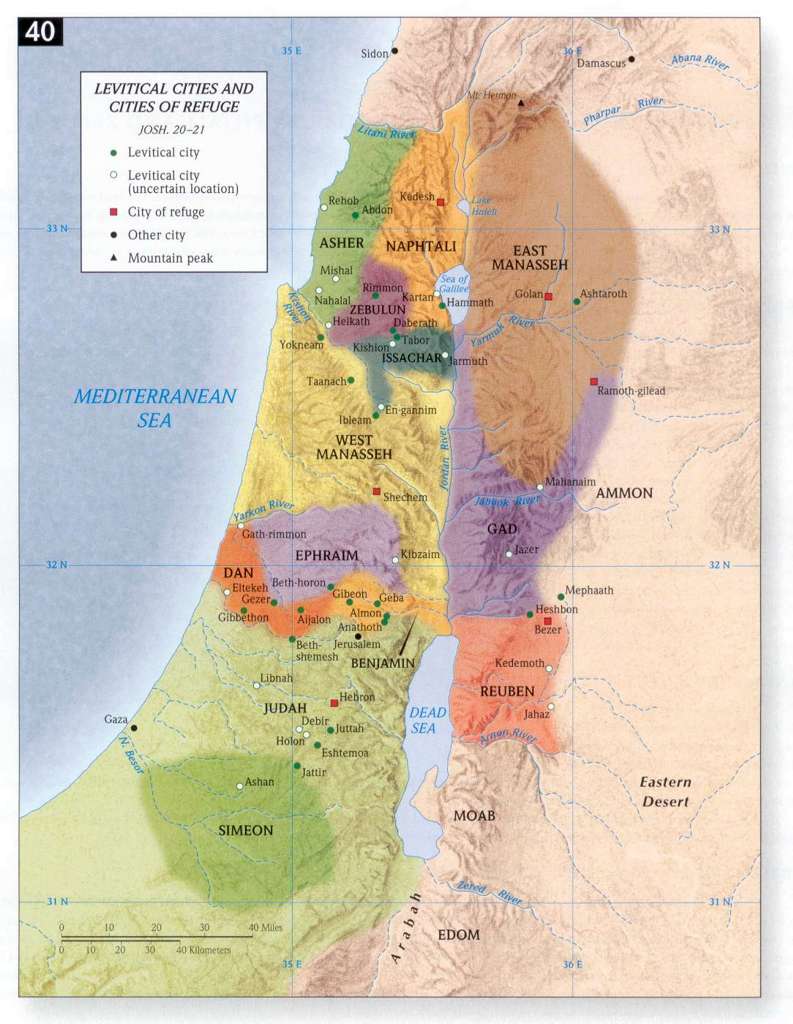
The map to the left (click to enlarge) displays the division of the Promised Land between the Tribes of Israel. The world map at the bottom right corner locates Israel at the eastern edge of the Mediterranean Sea along the important trade routes connecting historic Mesopotamia with Egypt to Israel's southwest and with Greece and Rome to its west across the seas.Geographically, Israel was split into east and west by the Jordan River with the Sea of Galilee in the north and the Dead Sea to the south. The area as a whole may be divided into four geographic regions: the coastal plains along the Mediterranean, the central hills (which run from the peaks in the north's Golan, through the hilly Galilee, down to the hill country of Judea in the south), the Jordan Rift Valley connecting the Sea of Galilee to the Dead Sea, and the Negev Desert in the south (which claims more than half of modern Israel's land area).
Recall that the twelve Tribes of Israel are the descendants of the twelve sons of Israel (renamed from Jacob). Of these twelve sons, lands were allotted to the tribes of Reuben and Gad on the east side of the Jordan while Asher, Naphtali, Zebulan, Issachar, Dan, and Benjamin were given lands on the west side of the Jordan and in the northern part of the Promised land. To their south were the lands of Judah and Simeon. Of Israel's other two sons - Joseph and Levi - the Levites became a priestly caste following their zeal for the Lord at Sinai in the punishment of 3,000 idolatrous Israelites. Rather than being given lands, the Levites governed a series of Levitical cities. As for Joseph, his descendants were given a double share in that his two sons Manasseh and Ephraim were adopted as sons in their own right by Israel and given extensive lands and prestige in the Promised Land (indeed, the northern half of the Promised Land would be known as "Israel" or "Ephraim" in later years). The capital of the northern kingdom of Israel? ... Samaria.
Around the year 732 BC, the northern ten tribes were taken into captivity by the Assyrians while the southern Kingdom of Judah was captured by the Babylonians in 586 BC. After the destruction of the Babylonian Empire by the Persians 539 BC, the people were allowed by Cyrus the Great to return and rebuild the Temple and the walls of Jerusalem. The area was captured by Alexander the Great in 333 BC and remained under nominal Greek control until the Maccabean Revolt from 166-160 BC. During that time, the Maccabean family forged the Hasmonean dynasty and expanded the kingdom to include Edom - one of Israel's old enemies to its southeast. In 139 BC, the Roman Senate recognized Israel as a Jewish state but later forced it to become a Roman client state in 63 BC. In 37 BC, the Romans overthrew the Hasmonean dynasty and replaced it with the more pro-Roman Herodian dynasty and its founder Herod the Great of Edomite lineage.
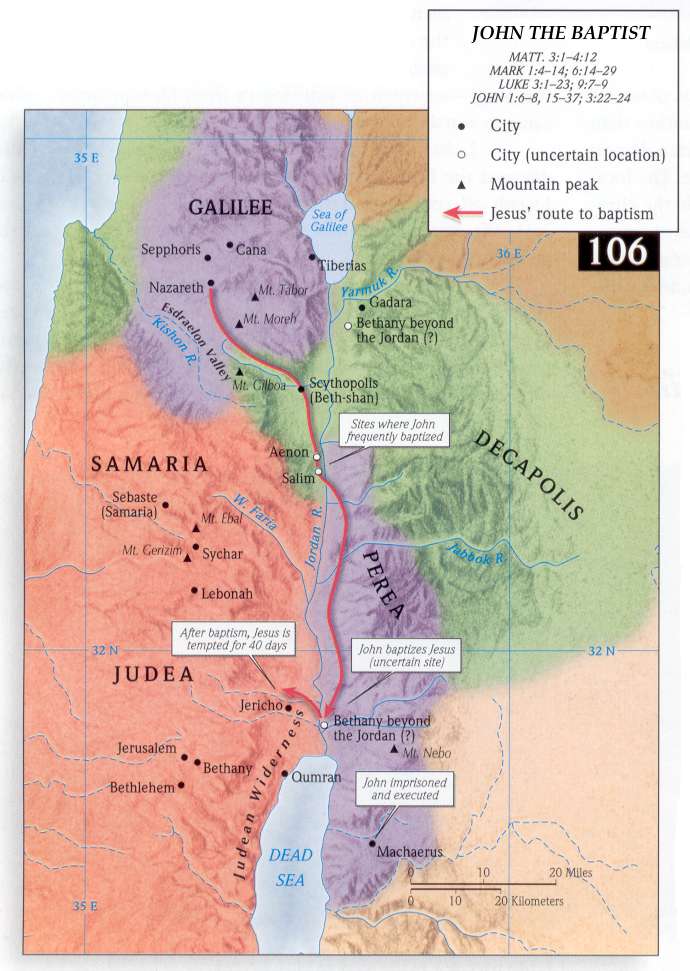
Upon the death of Herod the Great in 7 or 8 AD (click here to read Dr. Taylor Marshall's excellent work on dating Christ's birth and Herod's death), the kingdom was divided among his sons Archelaus, Antipas, and Phillip (see map at right). Rome soon decided to unify Samaria (which included much of the old northern kingdom), Judea, and Idumea (Edom) into one province called Iudaea. The capital of this province, however, would not be Jerusalem but Caesarea on the Mediterranean coast. Part of this administrative change was Roman rule over the province through its governors or procurators, the fifth of which being Pontius Pilate from 26-36 AD. Not included in this new province was the region of Galilee - an area vastly different from its southern neighbor. Perea, where John the Baptist preached and baptized, and Galilee remained under the rule of Herod Antipas (who beheaded John the Baptist and partook in the trial of Jesus because most of Jesus' ministry occurred within his realm).The majority of Jesus' public ministry took place in Galilee. Seven centuries after the dispersal of the northern tribes, the Galileans were mostly non-Jewish, though some towns (Nazareth and Capernaum) and all of the "men of Galilee" who were Christ's apostles were Jewish. Only Judas Iscariot of the apostles and Jesus himself were from Judea. To the south and west of Galilee were Samaria and Judea, both places where Jesus spent a great deal of time (He was born in Judea's Bethlehem, 5.5 miles south of Jerusalem). To its southeast was the Decapolis - an area of ten cities deeply influenced by Greco-Roman culture and majority Gentile in population. It was in the Decapolis that Jesus exorcised a possessed man in Mark 5, and from this man that word spread throughout the Decapolis about Christ. In Tyre to the northwest, Jesus worked another exorcism among a heavily Gentile population. Jesus also traveled into the far northeast. It is here that we find Caesarea Philippi, the site where Jesus changed Simon's name to Peter, made him the rock upon which the Church would be built, and gave him the keys to the Kingdom.
Saturday, April 8, 2017
Religion and Geopolitics Review: Saturday, April 8
by Dr. David Pence and A. Joseph Lynch
I. WEEKLY BRIEF
On April 4, 2017, a suspected sarin gas chemical weapons attack killed at least 85 people and sickened nearly 600 in the northwestern Syrian town of Khan Sheikhoun. The origin of the attack was disputed but the US expressed a high level of certitude in blaming the Assad government. In October 2013 Syria had joined the Chemical Weapons Convention vowing to relinquish its arsenal. The Trump administration in the last several weeks sent clear signals that the removal of Assad as president of Syria was no longer US policy. President Trump did not feel he could allow Assad's use of sarin gas as a response to his "peace feeler." On April 7 the US struck the Syrian Shayrat air base with Tomahawk missiles. The US believes that planes from Shayrat initiated the chemical attacks. The Russians were given a warning just before the attack to prevent unintended escalation. This was a clear message that chemical weapons would not be tolerated. In an important way this gives Trump more room for his initiative with both Russia and Syria. Senator McCain and Hillary Clinton both expressed hope Trump would escalate his response and adopt their shared policy of creating a no-fly zone to directly confront Russia and recommit the US to the salafist jihadists now fighting Assad. President Trump is not Barack Obama and even more importantly, he is not John McCain or Hillary Clinton. His attack does not constitute a strategic change yet. It was a measured particular response to an unexpected and reprehensible act that crossed a "type of weapons" line that is also an integral dimension of international relations.
There are two wars in Yemen -- one we should fight and one we should condemn. The fight we should condemn is the Saudi bombing of the Shiite Houthis. This is a hateful religiously based attack led by the young Deputy Crown Prince to curry favor with the Wahhabi clerics in his bid for succession after his father dies. There are a lot of older better men between him and the throne, but he is his father's beloved son and he needs to show the clerics he is serious in his all-out war against Shiites (not Iran per se but Shiites). The war the US should fight is against AQAP and ISIS, both Salafist Sunni groups who have a particular mission to direct attacks against Crusader nations in their homelands. Needless to say the Saudis have not been vigorous in fighting the Sunni Salafists. In fact by degrading Houthi forces, the Saudis have given AQAP much more room to maneuver. Making these critical strategic distinctions based on a knowledge of geography, history and communal loyalties is the only way one can seriously discuss "the war in Yemen." The US needs a group of strong patriotic senators who will open a serious strategic discussion of our enemies, allies, and goals in the Mideast. Long overdue.
I. NATIONS R&G ROUND UP
LIBERALS SEE RUSSIANS AND AMERICAN CHRISTIANS HAVE A LOT IN COMMON - THEY ARE RIGHT: From the Atlantic.
AN INTERVIEW WITH RUSSIAN FOREIGN MINISTER SERGREY LAVROV: Why can't we work with these grownups? The depth of historical and geographic understanding in these conversations should shame the hysteria of John McCain and Lindsey Graham as well as the conspiracy theorists of a "Russian under every bed" Democrats.
ON CHINA - DIPLOMACY NOT ENCIRCLEMENT: A different approach advised.
GIBRALTAR - A BRITISH COLONY ON THE TIP OF SPAIN: Ishaan Tharoor writes a daily column for the Washington Post called World Views. He is full of geographical and historical knowledge and a fine writer. He is pathologically anti-Trump which we can ascribe to his own historical and geographic milieu. Here is his fine introduction with maps of the Gibraltar dispute post Brexit. See also our Map on Monday: Gibraltar.
II. CULTURE OF LIFE, CULTURE OF PROTECTION
A BLACK MAN AND A WHITE MAN ON HOW TO PROTECT YOUR MARRIAGE: Mike Pence and Ta Nehisi Coates.
DENNIS PRAGER ON DISTNCTIONS THAT ARE GOD'S SIGNATURE IN CREATION: His speech to Christians living by the Torah. Here is Mr Prager speaking for 40 minutes about the Torah and its huge stress on "separations" (e.g., life & death, animals & humans, God & man, holy & profane, male & female, good & evil).
THE PRIESTHOOD OF THE TRANSGENDERED: Well put.
ANTHONY ESOLEN ON THE LAND O LAKES STATEMENT 50 YEARS AGO ON AMERICAN CATHOLIC UNIVERSITIES: He calls it the Suicide Pact with nary the name of Jesus.
III. THE CATHOLIC CHURCH
"They forgot that the liturgical act is not just a PRAYER, but also and above all a MYSTERY in which something is accomplished for us that we cannot fully understand but that we must accept and receive in faith, love, obedience and adoring silence. And this is the real meaning of active participation of the faithful."GETTING TO KNOW ST. BENEDICT: Russell Hittinger talk on Benedict's Dark Ages and ours. Tom Hoopes from Benedictine College on Rod Dreher book 'The Benedict Option.' Patrick Deneen on Benedict Option, as well as Tony Esolen and Archbishop Chaput books.
"Political Europe is rebuked for abandoning or denying its Christian roots. But the first to have abandoned her Christian roots and past is indisputably the post-conciliar Catholic Church."
"...the final purpose of every liturgical celebration is the glory and adoration of God, the salvation and sanctification of human beings, since in the liturgy “God is perfectly glorified and men are sanctified” (Sacrosanctum Concilium, n. 7)."
"the serious, profound crisis that has affected the liturgy and the Church itself since the Council is due to the fact that its CENTER is no longer God and the adoration of Him, but rather men and their alleged ability to “do” something to keep themselves busy during the Eucharistic celebrations."
Whittaker Chambers understood that there is no West without Christianity, and Christianity fell first in the East. His take on Benedict who brought a MODERATE RULE to bear on a dissipating culture:
Clearly, a cleft cut across the body of Christendom itself, and raised an overwhelming question: What, in fact, was the civilization of the West? If it was Christendom, why had it turned its back on half its roots and meanings and become cheerfully ignorant of those who had embodied them? If it was not Christendom, what was it? And what were those values that it claimed to assert against the forces of active evil that beset it in the greatest crisis of history since the fall of Rome? Did the failure of the Western World to know what it was lie at the root of its spiritual despondency, its intellectual confusion, its moral chaos, the dissolving bonds of faith and loyalty within itself, its swift political decline in barely four decades from hegemony of the world to a demoralized rump of Europe little larger than it had been in the crash of the Roman West, and an America still disputing the nature of the crisis, its gravity, whether it existed at all, or what to do about it?
Benedict had been born, toward the end of the fifth century, of good family in the sturdy countryside of Nursia, which lay close enough to Rome to catch the tremors of its sack, in 410, by Alaric‘s West Goths (the first time in eight hundred years that the city had fallen) and the shock of its sack by the Vandals, who, in 455 completed the material and human havoc that the West Goths had begun. To a Rome darkened by such disasters, Benedict had been sent to school as a boy of fourteen or fifteen. There he was shaken by the corrupt customs of his schoolmates, it is said. But we may surely conjecture that he was touched, too, like sensitive minds in our own day, by a sense of brooding, indefinable disaster, of doom still incomplete, for the Dark Ages were scarcely more than begun.
The boy fled from Rome, or, as we might say, ran away from school, and settled with a loose-knit congregation about thirty miles from the city. There he performed his first miracle. When, as a result, men called him good, he fled again. For, though he was a boy, he was clearly old enough to fear the world, especially when it praises. This time he fled into the desert wilderness near Subiaco, where for three years he lived alone in a cave. To those who presently found him, he seemed more like a wild creature than a man. Those were the years of the saint’s conquest of his flesh, his purgation, illumination, and perhaps his prayerful union with God. They must also have been the years when he plumbed all the perils of solitary austerities and the hermit life, by suffering them.
At any rate, the saint left Subiaco to enter on his first experience in governing a community of monks. He returned to Subiaco, and, in twelve years, organized twelve Benedictine communities. His days were filled with devotion and with labor and touched with miracles. But again human factors threatened failure. St. Benedict with a few companions withdrew to Monte Cassino, some eighty miles southeast of Rome. There he overthrew an ancient altar of Apollo (for paganism was still rooted in the countryside), and there he raised his own altar. On those heights, he organized his community, ruled his monks, performed new miracles, distilled his holy experience in his Holy Rule. There he died at a date which is in dispute, but was probably about 547, when the campaigns of the Eastern Roman Empire to recover Italy from the East Goths had so permanently devastated the Peninsula that the irruption of the Lombards into the ruins brought a new horror rather than any novelty in havoc.
Against that night and that ruin, like a man patiently lighting a wick in a tempest, St. Benedict set his Rule. There had been other monastic Rules before—St. Pachomius’ and St. Basil’s, for example. St. Benedict called his the Holy Rule, setting it down and setting it apart from all others, with a consciousness of its singular authority that has led some biographers to speculate whether he had not been prompted by the Holy See to write it. Perhaps it is permissible to hazard that his authority need have proceeded from nothing more than that unwavering confidence which commonly sustains genius.
What was there in this little book that changed the world? To us, at first glance, it seems prosaic enough, even fairly obvious. That, indeed, is the heart of its inspiration. In an age of pillar saints and furiously competing athletes of the spirit, when men plunged by thousands into the desert, in a lunge toward God, and in revulsion from man, St. Benedict’s Rule brought a saving and creative sanity. Its temper was that of moderation as against excesses of zeal, of fruitful labor as against austerities pushed to the point of fruitlessness, of discipline as against enthusiasm, of continence of spirit and conduct as against incontinence.
It has been said (by T. F. Lindsay in his sensitive and searching St. Benedict) that, in a shattered society, the Holy Rule, to those who submitted to its mild but strict sway, restored the discipline and power of Roman family life. I venture that it did something else as well. For those who obeyed it, it ended three great alienations of the spirit whose action, I suspect, touched on that missing something which my instructors failed to find among the causes of the fall of Rome. The same alienations, I further suspect, can be seen at their work of dissolution among ourselves, and are perhaps among the little noticed reasons why men turn to Communism. They are: the alienation of the spirit of man from traditional authority; his alienation from the idea of traditional order; and a crippling alienation that he feels at the point where civilization has deprived him of the joy of simple productive labor.
These alienations St. Benedict fused into a new surge of the human spirit by directing the frustrations that informed them into the disciplined service of God. At the touch of his mild inspiration, the bones of a new order stirred and clothed themselves with life, drawing to itself much of what was best and most vigorous among the ruins of man and his work in the Dark Ages, and conserving and shaping its energy for that unparalleled outburst of mind and spirit in the Middle Ages. For about the Benedictine monasteries what we, having casually lost the Christian East, now casually call the West, once before regrouped and saved itself.
So bald a summary can do little more than indicate the dimensions of the Benedictine achievement and plead for its constant re-examination. Seldom has the need been greater. For we sense, in the year 1952, that we may stand closer to the year 410 than at any other time in the centuries since. If that statement seems as extreme as any of Salvian’s, three hundred million Russians, Poles, Czechs, Slovaks, East Germans, Austrians, Hungarians, and all the Christian Balkans, would tell you that it is not—would tell you if they could lift their voices through the night of the new Dark Ages that have fallen on them. For them the year 410 has already come.
[Mr. Chambers' essay forms a part of "Saints For Now," edited by Clare Boothe Luce, published by Sheed & Ward. -- copyright 1952 Sheed & Ward, Inc., New York.]
Friday, April 7, 2017
Friday BookReview: Bruce Catton and Appomattox
[first published May 1, 2015]
This book has had a towering impact. So, when a historian at Western Kentucky University drew up a list of the twelve best books on the Civil War, it was no surprise that Mr. Catton's work was chosen #1.
An excerpt from the professor's comments:
Published in 1953, A Stillness at Appomattox details the experiences of the Army of the Potomac during the final year of the war, but it is much more than a retelling of an often told tale. In fact, one could say this book is a prose poem to the Army of the Potomac and the men who fought in it.
As a child growing up in Michigan, Catton knew and spoke to Civil War veterans in his small hometown. Although a good part of his career was spent as a newspaper journalist and columnist, he took up writing Civil War books in the 1950's, became the senior editor of American Heritage magazine, and gained great fame as an author until his death in 1978. Catton wrote not only with a journalist’s eye, but also with a novelist’s sensibilities (although he published only one novel on the Civil War for juvenile readers)...
Catton forged a trail for later Civil War historians by writing his account of the Army of the Potomac from the point of view of soldiers in the ranks. By means of lilting sentences, adroit portraits of men and their peccadilloes, and iron-hard descriptions of men in battle, Catton turns the Army of the Potomac into more than a mass of men in wartime; his picture of the army and its soldiers convinces you that he was there with them, which of course he wasn’t, but you feel that anyway because his narrative carries you back into the world in which those soldiers lived and died. Beneath the surface of Catton’s chronicle runs the awful specter of the tolls of war — how war dehumanizes, stultifies, and yet breeds comradery, trust and even love among those who wage it. Long before academic historians turned to highlighting the “face of battle” in their military studies of the Civil War, Catton sketched accurately and effectively the dour features of that face.
More to his credit, Catton discussed — in this book and in others — how slavery was the cause of the war, the plight of slaves and freedmen as the war wore on, and the importance of the Union cause as a driving force behind the determination of Northern soldiers to win the war and reunite the country. This book leaves sharp images lingering in the reader’s mind, largely because Catton expertly sets scenes, describes people in human terms, and refuses to disguise the ugly, malevolent and heartless aspects of war. Yet, in the end, the book is surprisingly uplifting, a splendid tale of victory, no doubt because Catton so adeptly uses irony and compassion to tell the Army of the Potomac’s story. Walt Whitman once famously said, “the real war will never get in the books.” He was wrong. The real war, in all its dimensions, can be luminously found in this, the best book ever written about the Civil War.
![]() |
| President Eisenhower at Gettysburg with the historian |
This is a review posted by a reader (at Amazon):
Catton's book tells the story of the Civil War in the East beginning in the winter of 1863 following the Battle of Gettysburg. The first thing to notice about the book is the clear, lyrical quality of the prose... Also Catton has a gift for lyrical metaphors to drive home his points -- whether in describing the fields or in describing the emotions of the men. His writing at its best has a poetical, moving quality. Most importantly, Catton writes lucidly. His descriptions of the battles and of troop movements are relatively easy to follow. Many of the accounts I have read since I first tried this book are detailed and ponderous. This is never the case with Catton. He gives a good, basic picture of the battles he describes which will stand the reader looking for more detailed accounts in good stead.
Besides the quality of the writing, A Stillness at Appomattox is notable for the story it has to tell. Broadly speaking, Catton focuses on how the Civil War changed after its first two years, and he explains why. Although the carnage of the first two years of the war was immense, the scope of the war increased markedly following Gettysburg. The Civil War became the first total war, bringing trench warfare, sustained fighting, destruction of property, and hardship to noncombatants in its wake. Many later writers have also made this point, but Catton unforgettably drives it home.
Catton thus describes the final Union campaign in the East (there is little in the book on the Western theatre of the war) of the Army of the Potomac from the Wilderness through Spotsylvania, Cold Harbor, Petersburg, and Appomattox. He describes the desperate, harsh nature of these engagements under the leadership of U.S. Grant. Catton also pays a great deal of attention to Philip Sheridan, to the destruction he wrought in the Shenandoah Valley Campaign, and to his key roles in the Battle of Five Forks (Petersburg) and the final race to the Appomattox Court House. Catton's discussion of Sheridan brought home to me the cruel all-out nature of the final stages of the war.
Catton also integrates well the military aspects of the Civil War with the political aspects. There are good pictures of Lincoln and of the war-weariness of the North which threatened the military efforts of the armies until the last phases of the conflict... Although Catton writes from the Union side of the line, he clearly is impressed with the military and personal character of Robert E. Lee and with the valor shown by the Army of Northern Virginia under the most trying of circumstances.
I was enthralled by the pace of the book, by Catton's writing, and by his love for and knowledge of his subject. This is a book to come to as an adult. It will encourage the thoughtful reader to reflect upon the Civil War as the watershed event in our nation's history.
April 12, 1861: Fort Sumter is fired upon by Confederate forces
April 9, 1865: General Lee surrenders to Grant at Appomattox
The 150th anniversary of the surrender ceremony was re-enacted several weeks ago. Click on some of the coverage from CBS, and a short video from C-Span about the family home where the original meeting took place.
UPDATE: Another big fan of Mr. Catton's classic is Scott Johnson at "Powerline" blog.
![]() |
| Old antagonists at North/South reunion |
Subscribe to:
Posts (Atom)