RELIGION, NATION, MARRIAGE: THE LOYALTIES OF MEN
PRAY, WORK, STUDY, PROTECT: THE DUTIES OF MEN


Friday, March 8, 2013

Two battles a thousand years apart


As the eighth century dawned, the powerful Muslim armies continued to advance northward on Europe.  In 732, however, at the Battle of Tours (southwest of Paris) they were finally stopped – by Charles “the Hammer” Martel.

[This was exactly a century after the death of Muhammad].


The Franks were greatly outnumbered by the invaders on horseback, but Martel had chosen the terrain of engagement.

With this stunning victory, Martel – grandfather of Charlemagne – laid the foundation for the European Middle Ages.


In 1683 – more than nine hundred miles to the East at Vienna – the Ottomans were defeated by the Christian forces commanded by the Polish king, Jan Sobieski.

(The Polish, German, and Austrian armies were fewer than the Turkish soldiers led by the Grand Vizier.)

Sobieski said that his purpose was “to proceed to the Holy War, and with God’s help to give back the old freedom to besieged Vienna, and thereby help wavering Christendom.”

From an account:
On September 11th, Christian forces arrived on a small hill overlooking Vienna known as Kahlenberg and drove off an Ottoman observation force. They then lit up three large torches to let the Ottomans and the defenders know of their arrival…

In the early morning dawn of the next day the Catholic troops held Mass while the Protestants held their own service, both prayed for victory…
[At the end of the day with the Turks on the run] Sobieski was the first to reach the Grand Vizier’s tent from which he received the delirious and joyful cheers of his army and the defenders of Vienna as the savior of Europe. The city was saved. 
As the allied troops plundered the camps, Jan III took the time to dictate a letter to the Pope by which he would report his victory to the whole of Europe. In this letter he made his famous paraphrase of Julius Caesar’s dispatch from the battle of Zela in 47 BC:
“Venimus, Vidimus, Deus Vicit” – We Came, We Saw, God Conquered.


Thursday, February 21, 2013

Practicing Catholics, Social Justice, and Educational Reform


Dr. Pence writes:

Catholic education involves a generation of parents and teachers transmitting to students a communal practice that tells them the story of the world; and introduces them to the main characters of that drama eliciting love of God, hatred of Satan, affection for Mary, admiration of the saints, and love for one another. The daily and weekly rhythm of prayer, penance, Mass, and confession introduces students to a realistic comprehensive explanation of the external world while cultivating within them the beginning of a reflective interior life. The story we tell them and the characters we introduce to them are more fantastic than any movie or play. So our challenge is to communicate that a tale so incredible is, in truth, the nature of reality.

                 
This starts with a daily insistence for young children that they are the bearers of a spiritual soul that sets them quite apart from their pets and plants. This personal awareness of the human spiritual soul and a distinct language describing the soul’s faculties and characteristics are not to be confused with “we are all special.”  The practice of examining one’s conscience and receiving the Eucharist in one’s soul are experiences of interiority that are utterly foreign to the modern psychology of personal identity. Yet many of us enjoyed a firm grasp of this interior reality at age seven – and so did our best friends.  These sacramental practices are the educational pillars of the interiority needed for young people to eventually grasp the larger reality that the physical universe manifests a spiritual cosmos.

Genuflecting in a sacred space to a Sacred Presence orients muscles and memory to a sacred order. Seeing a pregnant woman as a temple harboring a sacred life is a lot easier for children brought up genuflecting to a tabernacle holding the Body of Christ.  The special days of feast and fast – telling an annual narrative –  turn the “one thing after another” of chronos time into the historical sense of religious time imbued with both direction and purpose.  Finally, the sacralized and forbidden speech patterns of the Catholic liturgy and commandments impress upon our students the terrible power of language and the word for good or evil. We train our students with actions that inform their thoughts and words. These practices permeate the life of a normal Catholic school, parish, and family.

Prayer and public worship are the inevitable consequences of learning about and knowing God.  Proper worship orients faculty and students to the hierarchy of knowledge that orders them in relation to time, place, purpose, and person. Fortunately, these acts of religious piety do not make students or teachers forget periodic tables, geometric relationships, historical events, or English grammar. Acts of piety, keeping time together, and sharing an ordering language toward the ultimate truths establish a powerful communal lattice for learning. This corporate characteristic that gave the University its name is precisely what modern overspecialized schools have lost.  It is the unitive mark of any truly Catholic school.

The restoration of Catholic education by first insisting on Catholic practices permeating the student experience of time, space, and language will involve a serious redeployment of funds, and a renewal of religious mission from the self-serving employees' cartel that now control most of our institutions. The ecclesial duty to educate the Catholic faithful who fill our parishes (but are unable to afford our University and high school tuitions) will not be embraced by many of the lay and clerical ministers who presently absorb the bulk of our annual $12 billion parish and diocese income.  They will counter all significant movements of reform with an inflationary view of workplace justice, a parasitic generational subversion of gender equity, and an attempt to elevate bureaucratic tenure as a sacramental of infinity.

The proper disposition of land, buildings, and job opportunities is a true social justice issue which will pit Catholic careerists who have lost their faith -- but maintain control of the Catholic infrastructure -- against immigrant and large-family Catholics, as well as the urban poor, who need to be educated, married, and buried inside the dense social capital capacity of the Catholic Church and her institutions. The bishops will decide the matter after they face it.

Less than 15 percent of parish income (fifty years ago it was 63%) is dedicated to Catholic grade schools. Meanwhile, salaries for nuns and clergy in the justice ministries, hospital systems, and Catholic universities make even a previous purse-snatcher like Judas Iscariot seem like a fool for chump change.  (Annual salaries of Fr. Larry Snyder of Catholic Charities - $220,000; Sister Carol Keehan of Catholic Health Association - $600,000 with  $900,000 total compensation; Fr. Dennis Dease, President of University of St.  Thomas - $300,000. The female discrepancy here is retributive payback for historical institutional sexism).

A large subsection of the Sixties generation of clerics, nuns, and lay ministers have interrupted the great inter-generational transmission of faith, wealth, and sacrificial service which constitutes Catholic Tradition.  Those spiritual truths which they did not accept in humble gratitude, they have not transmitted with convincing authority.  Those material possessions lent to them for service to the next generation, they have expropriated for themselves as a “just wage.” This generational act of narcissistic disruption has betrayed the evangelical promise of Vatican II, and squandered the Catholic immigration potential for the Christianization of American civic culture.

The restoration of Catholic education awaits a return to the practice of the sacramental faith by Catholic educators and parents. It will involve closings and firings, and re-openings and conversions, and lots of talented volunteers and lots of very low-paid clergy and nuns. Practicing Catholics are the best social justice movement of all because we start by giving God His due in worship and end up educating and integrating the immigrants, the widows, and the orphans in the life of the Church and city.

Saturday, February 16, 2013

Chinese government taking same tack as Bourbon France


The photo is from the Tiananmen Square protests of 1989.  An excerpt from a recent magazine essay on today’s China:
All of which should leave the regime feeling secure in its own position. Yet it hardly acts that way. "They're acutely aware of the risk," reports one diplomat, describing how closely Beijing watched the Arab spring, seeking to learn from the ousted despots' mistakes. One immediate response was to prevent the possibility of large crowds, flooding popular areas with security personnel to disperse potential groups, even ordering street-sweeping vehicles to drive closer to the pavement in order to keep people moving. There may be some freedom of speech in today's China, but there's next to no freedom of association.

The passage called to mind Tocqueville’s stress in Democracy in America on the importance of associations.

The historian Leo Damrosch on the Frenchman’s visit to Philadelphia:
“It happened that a free-trade convention, opposed to the protective tariff that was highly controversial at the time, was about to meet in Philadelphia, while the tariff’s supporters… would be meeting simultaneously in New York.  Neither assembly would have had the slightest chance of happening in France.  Tocqueville was impressed that the First Amendment to the Constitution expressly guaranteed ‘the right of the people peaceably to assemble, and to petition the government for a redress of grievances.’  It is not easy today to appreciate how radical that right once was.  French law prohibited any assembly of more than twenty people unless they had obtained official permission, and Tocqueville lamented, ‘What can public opinion itself do when twenty people may not assemble in one place, and when there is no man, family, group, class, or free association that can declare its views and act upon them?’ ”


The holy hopeful patriarch of Nigeria


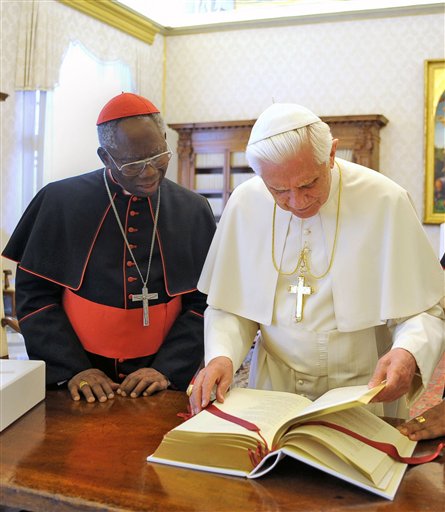
If any Catholic still finds himself in a sepulchral mood by the decision of Benedict to step down as Holy Father, he should watch this short video of Cardinal Arinze.  Overflowing with the Holy Spirit – but too old to vote in the upcoming conclave – he leaves one with a more solid assurance that the good men inside the Barque of Peter will always outnumber the bad.


Monday, February 11, 2013

Spiritual Reality and a full tonal palette of Emotions

by Dr. David Pence

G.K. Chesterton wrote that a man who did not regard the devil as real, would forever picture reality on too drab a canvas.  Artists describe tone or value as the shades and tints of colors—how bright is the brightest and how dark is the darkest.  A “high key” painting employs a full range of tones and it affects how all the colors (hues) interact.

If our understanding of reality includes the full cast of characters – the whole dramatis personae from the eternal triune God to the fallen angelic creature Lucifer – then we will need a full tonal palette of emotions to respond to these beings. Our love should always dominate and surpass our hatred. God deserves a much deeper emotion than His adversary.

If we have no hatred for the devil in our emotional palette, then we are not apprehending and responding properly to Reality. If we lack this hatred, two very different pathologies can ensue. This deficit tends to dull a particular set of emotions: anger at injustice, aversion to evil, and fear of Hell. This is the tonal error of the American bishops.

On the other hand, hatred without its proper object may run amuck and consume us in hatred of our father or President; or some past personal malefactor; or a perceived racial or class enemy. That is the emotional tonality of the sexual Left. Man cannot disengage from the basic truths of reality—not in his comprehension and not in his emotional response.  He must employ all tonal values of his emotions because the picture of revelation has been drawn in high key.